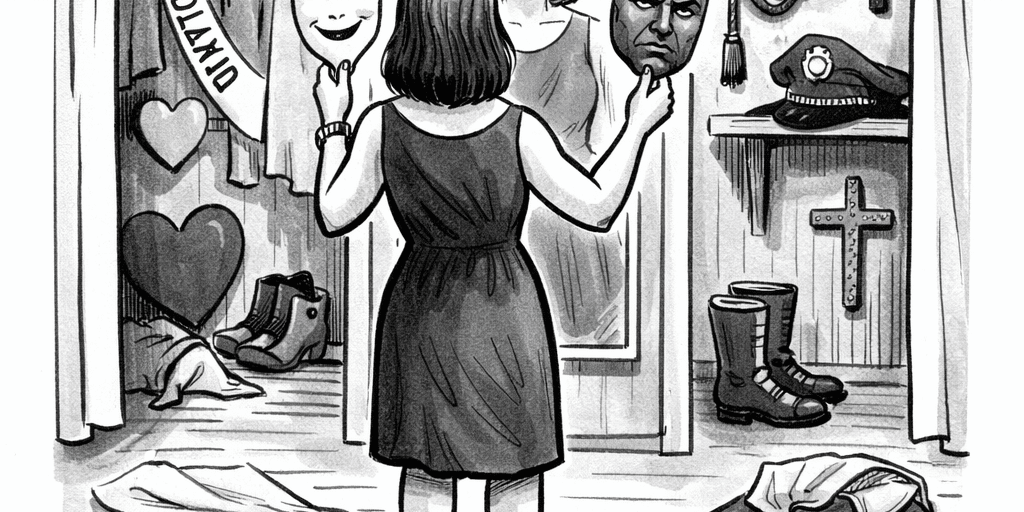
“ESA NO SOY YO”: So Who The Hell Is She?
If you don’t follow Spanish regional politics, the name María Guardiola may not mean much to you. She is the current president of Extremadura, one of Spain’s poorest regions — a place rich in history, agriculture, and chronic underinvestment. But her recent political trajectory offers something far more universal than local intrigue: a near-textbook case of public contradiction, compressed into a single, almost surreal arc.
In June 2023, Guardiola made a very public stand. She declared she would not form a government “at any price,” specifically rejecting a coalition with the far-right party, whose positions on gender violence and equality she openly criticized. Her line — “esa no soy yo” (“that is not who I am”) — became the core of her political identity.
Days later, she did exactly that.
What followed over the next two and a half years was a sequence of reversals, escalating stakes, and increasingly strained justifications: governing with the very party she had rejected, breaking with them, then calling unnecessary elections in an attempt to free herself from them, failing to do so, and ultimately returning to the same arrangement — this time while claiming her feminism aligned with theirs.
The piece I’ve written is not just about contradcitions, but about the elasticity of political identity itself — how a public figure can declare a fixed moral core and then continuously redefine it without ever acknowledging the break.
If you read Spanish, you can find the full article here:
👉 https://elcuadernodigital.com/2026/02/25/esa-no-soy-yo-entonces-quien-demonios-es/
A full English translation follows below.
“ESA NO SOY YO”: So Who The Hell Is She?
An Autopsy of the Many, Many María Guardiolas
She said it herself, loudly, deliberately, with the ceremonial gravity of someone signing a contract with history in permanent ink. She said it with the absolute conviction of a woman who had stared into the glittering abyss of power and announced, for the benefit of the cameras, that she would rather chew broken glass than blink.
June 20, 2023. The cameras were rolling, red lights glowing like warning beacons; the microphones were live, no accidents here, no stray whisper caught by chance. This was theater, scripted by destiny and delivered at full volume. María Guardiola, president-in-waiting of Extremadura, lifted her chiseled chin toward the assembled press in Mérida and fired off the phrase that was meant to fossilize her political identity: “El camino más fácil hubiera sido ceder y ser presidenta a cualquier precio y traicionar a mi tierra y lo que dije en campaña, pero no. Esa no soy yo.” The easy path, she said, would have been surrender, to take the office at any price, betray the land, betray her word, grab the keys and run. But not her. Never her. “Esa no soy yo.” Four words, polished and displayed like a coat of arms. Her entire identity, compressed into a slogan. Her political soul, bottled, labeled, and held up to the light for public inspection.
She was, at that precise moment, something genuinely rare in the political species: a person apparently willing to go to new elections rather than compromise her principles. She would not sign, she said, “un acuerdo asimétrico y lleno de condiciones.” She would not hand out regional ministries. She would not engage in the culture wars. She claimed to believe in a modern Extremadura, she announced, “donde el amor no admita matices” — where love admits no caveats. She had arrived in politics without previous debts. She was free. And the party that was asking her to betray herself — Vox, the party whose leader she had described as arriving in Mérida like “el capataz del señor feudal,” the feudal lord’s overseer, to tell the people of Extremadura what to think — that party was not going to get what it wanted. Because she was who she was. And who she was was not that.
It lasted less than an open bottle of milk. Before the echo had died, before the phrase “esa no soy yo” had even fully evaporated from the dry Extremaduran summer air, she had formed a coalition government with the capataz’s party, handed over portfolios, and assumed the presidency that she had declared she would never obtain at any price. The price, it turned out, was modest — only the entire warehouse of previously declared principles, sold wholesale, forklift included, invoice stamped urgent. The price was everything she had said she stood for. Ladies and gentlemen, that is some efficient pricing, the kind normally associated with liquidation sales or minor military coups. Most politicians take years to sell their souls, María Guardiola did it at a sprint, and had the extraordinary gall to remain standing at the podium of her own integrity while doing it.
And it matters who she governed with, because Vox is not a neutral quantity. This is a party that has been the sole parliamentary force in Spain to refuse renewal of the Pact Against Gender Violence. A party whose framework — dissolving “violencia de género” into the softer, more politically convenient “violencia doméstica” — has been specifically criticized by the UN’s CEDAW committee and the Council of Europe’s GREVIO experts as a violation of the Istanbul Convention, as a mechanism that strips away the structural protections women have fought decades to obtain. A party that has, in the municipalities it controls, quietly dismantled equality offices and cut funding to victim support organizations. A party whose candidates have included figures with documented histories of the very violence the party denies is real. Guardiola had called all of this out by name. She had said she could not — could not — allow people who deny gender violence to enter her government. Not won’t. Cannot. As if it were a law of physics. And yet she did.
By December the whole refrigerator of promises had gone sour with the coming of the second act of this theater of the absurd, the unnecessary election of Christmas 2025: a multi-million euro exercise in self-delusion paid for by one of Spain’s poorest regions, called on the basis of a calculation that every single poll demolished before the ballots were even printed. The fever dream went that she would get a majority. She would no longer need Vox. She would be liberated from the uncomfortable marriage and the even more uncomfortable memory of “esa no soy yo.” Except — as every analyst, every survey, every functioning barometer of political reality cheerfully confirmed in advance — this was not going to happen. And surprise surprise, she didn’t get it.
During that campaign — during the doomed, expensive, thoroughly foreseeable campaign — she delivered herself of another magnificent declaration: Abascal, she said, gave off a “tufo machista,” a whiff of machismo. She recoiled from it theatrically. She was not going to be that. She had standards, a nose, a moral immune system apparently capable of detecting ideological odor. But standards, as we have now established at considerable public expense, are seasonal in Guardiola’s world. The negotiations began again after December. The old dance resumed. And then, in February 2026, in an interview with Okdiario — a publication that has never met a right-wing provocation it didn’t love — she delivered the sentence that has stunned the nation, and that invites every serious observer to ask: who, exactly, is she? “El feminismo que defiendo estoy convencida que es el feminismo que defiende Vox.”
There it is. That is the full arc. From “esa no soy yo” to “el feminismo que defiendo es el mismo que el de Vox” in thirty-two months, slightly longer than the gestation period of an elephant. From the woman who would not betray her land for the presidency to the woman who has now, twice, betrayed everything she claimed to believe in order to hold power over it. From the politician who looked the cameras in the eye and said she would not enter into culture war battles to the politician telling us that her feminism — her feminism — is indistinguishable from that of a party whose relationship to gender-based violence is to deny that it is gender-based. “Esa no soy yo” has become an epitaph for whatever she once was, if indeed she was ever that thing at all.
Meanwhile, out on the dry frontier province that Madrid remembers mainly during budget negotiations, the citizens of Extremadura continue their ancient ritual: paying taxes, exporting their children, and watching televised press conferences the way medieval villagers watched comets — as omens of something expensive. The region has long been a reservoir of labor and a postcard of landscapes and a footnote in the ledgers of those who hold the economic levers. It has given Spain conquistadors and emperors and its bone-deep agricultural wisdom, and in return it has received, among other things, this: a leader who calls new elections at public expense to escape a coalition she then reconstructs, who denounces the feudal lord’s overseer and then governs at his pleasure.
So let us ask the question directly, the one that her own most famous phrase demands: if the woman who said “esa no soy yo” in 2023 is not her, and the woman who now shares Vox’s feminism is apparently her, then who is she? Which one gets to be real? Which María Guardiola is governing Extremadura? Is it the one who “llegó a la política sin hipotecas” — without mortgages, she said, free, unencumbered — or the one who has now mortgaged the very language of feminist politics to the party she once described as the feudal lord’s enforcers? You cannot be both. You cannot be the woman who refuses the presidency at any price and the woman who has paid any price. The logical universe will not allow it, even if the political universe, in its magnificent indifference to consistency, tolerates it daily.
Extremadura deserves to know. The noble people of this land — who have endured centuries of being an afterthought, a labor supply, a scenic backdrop for other people’s prosperity — deserve, at the bare minimum, a president who is someone. Someone specific. Someone whose convictions do not evaporate between press conferences. Someone who, when she looks into the camera and says “esa no soy yo,” means it past the next week. The tragedy is not merely political. It is existential. She announced herself as something. She promised herself as something. And then — twice, at growing public cost, with increasing philosophical creativity — she became something else entirely and dared to call it consistency. Who is she? Extremadura, now governed by the faint yogurt smell of expired convictions, is still waiting for an answer. And the answer, so far, is that she is whoever she needs to be by Friday.