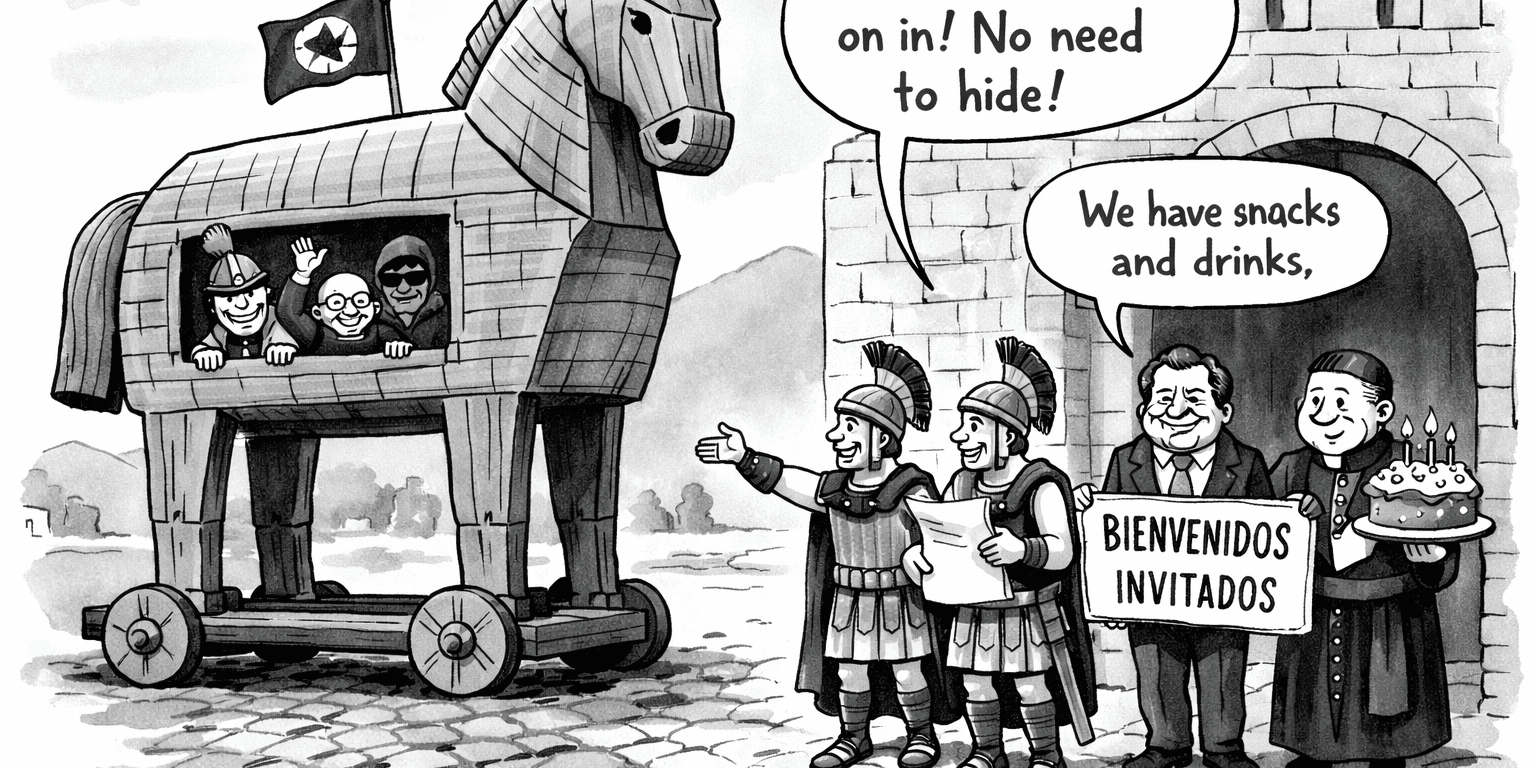
The Gates Are Open: Modern Troy Has No Horses
On Homer’s return, the right’s suicide pact, and the peculiar madness of men who invite their own devourers
There is something deeply reassuring about the fact that, in 2026, we have decided—collectively, enthusiastically—that what this moment really needs is more Homer.
Film studios are adapting The Odyssey. Theatre directors are reinventing Penelope. Musicals are turning Bronze Age trauma into Spotify playlists. Elon Musk is tweeting about Odysseus as if he were a productivity guru with a boat problem. The ancients, it seems, are trending.
Fair enough. If you were scripting current politics, subtle realism wouldn’t quite cut it.
What’s striking, though, is that we’re not living through a clever Trojan Horse scenario. There’s no deception, no infiltration, no grand strategy.
The gates are just… open.
In the U.S., the Republican Party wasn’t overtaken so much as absorbed from within. In the UK, Reform UK advances while the Conservatives experiment with becoming a less convincing version of it. Different contexts, same pattern: not resistance, not even collapse—something closer to accommodation with a hint of relief.
Spain adds an important wrinkle. Vox didn’t rise simply because of economic hardship; Spain has seen worse. What changed was the climate—the slow normalization of harder rhetoric, years in the making. By the time the political crisis arrived, the ground was ready.
And crucially: this didn’t come from outside. It emerged from within the ecosystem of the mainstream right, which is now negotiating with it in plain sight.
No horse required.
I explore this dynamic more fully—through Homer, Troy, and a slightly uncharitable lens—in the piece below:
🇪🇸 Spanish version (El Salto Diario):
https://www.elsaltodiario.com/extrema-derecha/puertas-estan-abiertas-troya-moderna-no-tiene-caballos
The Gates Are Open: Modern Troy Has No Horses
Homer is everywhere. And he has arrived, as he always does, precisely on time. You cannot swing a dead classicist these days without hitting an Odyssey adaptation. They are multiplying like suitors at Ithaca: Christopher Nolan is filming one; a new theatrical production reimagines Penelope entirely; EPIC the Musical has colonized the earphones of an entire generation. Elon Musk, and here the irony is almost chewable, has declared himself a devotee of Odysseus, while demonstrating, tweet by tweet, that he has never considered that the poem might be a warning and not a vibe. SpaceX named a lunar lander after the wily Ithacan. It lasted seven days, tipped sideways, and will not be returning. The gods, it seems, are not without opinions.
Why has Homer returned? The academics will tell you it is because Odysseus is polytropos — adaptable, morally elastic, a hero for unstable times. This is tidy, and therefore suspect. The less polite answer is that we are living through a moment so operatically deranged that only a Bronze Age poet can supply an adequate screenplay. Reality has outpaced realism. We require epic.
And the epic currently staging itself with the most vulgar enthusiasm is a dystopian version of Troy.
Let us dispense with euphemism. The traditional conservative parties of the democratic world — Germany perhaps the last holdout, and even there one hears the hinges creak — are not being infiltrated by the far right. The grand old parties are not decaying from the margins. They have swung open the gates. Not reluctantly, not under duress, but with something approaching relief. One can almost see the shoulders drop. At last, the waiting is over. Let them in.
The original Trojan Horse required ingenuity: carpentry, deception, men willing to crouch in sawdust, splinters and darkness for the promise of future ruin. What we are witnessing now has required none of that effort.
The horse has been rendered obsolete. The enemy is already inside, drinking the wine, kicking the furniture to pieces, delivering lectures on sovereignty and the despicability of anything foreign while crumbs fall from their mouths. And those tasked with defending the house are publishing essays about the importance of dialogue, as if one could negotiate with a man already eating the table.
I.
In the United States, the Republican Party — once home to Eisenhower, who warned against the military-industrial complex with the authority of a man who had actually defeated fascism — has not been captured so much as digested. The fringe did not storm the center (although it did the Capitol); it replaced it, cell by cell, until the organism woke up one morning speaking in tongues it no longer recognized.
This was not inevitable. History did not demand it. At each juncture there were decisions — small, cowardly, entirely legible decisions — to accommodate rather than confront, to indulge rather than isolate. Each made in the name of prudence. Each now revealed as surrender in instalments.
Britain, with its customary flair for ceremonial self-harm (Brexit anyone?), has produced its own accelerated variant. Reform UK advances with the speed of a pathogen in an immunocompromised host. The once proud Conservative Party, now a kind of political revenant wandering the corridors of opposition and asking after its missing limbs, faces the choice that gutless parties always face: recover the ground it ceded, or impersonate the forces that took it.
It is choosing impersonation. It always does. There is something irresistibly attractive, to a certain kind of politician, about becoming one’s own parody.
II.
And then here in Spain, where the metaphor curdles into something truly Goyesque — which is to say worse than Homeric, because Goya had the decency to abandon hope in the face of the coming storm.
The standard explanation for Vox’s rise is economic: inequality, housing, stagnation, a generation priced out of adulthood. The apology is neat. It is also wrong, or at least insufficient to the point of fiction.
Vox was founded in 2013, at the nadir of Spain’s economic collapse: 25% unemployment, austerity so sharp it drew blood, long food bank queues in a EU country that preferred not to see them. The result? Indifference. The electorate yawned.
Compare this with the mid 80s: even worse unemployment, catastrophic youth joblessness, inflation chewing through wages, heroin hollowing out entire districts. No Vox. A few nostaligic Falangists meandering the Rastro looking for memorabilia, but no palpable nationalist fever dream. The Socialists governed. The nascent democracy, by every available measure, enjoyed greater legitimacy under materially worse conditions.
Misery, it turns out, is not enough. People must be taught where to direct it. What Vox required was cultivation — a long, patient fermentation in cultural grievance, a steady rightward drift in the intellectual weather, the spread of social media and the normalization of what had previously been unsayable until it became merely emphatic. By the time the Catalan independence farce provided the spark, the forest had been drying for years. The fire, when it came, was almost a relief. At last, something to match the mood.
III.
Which brings us to the Partido Popular, and to a performance of political self-immolation so elaborate it begins to look like choreography.
The Spanish right emerged from Francoism the way a house emerges from a flood: after a rinsing, nominally clean, technically presentable, but with a dampness that never quite leaves the fabric. For decades, the PP attempted a kind of muscular moderation — conservative, centralist, Catholics, but with condoms, recognizably committed to the constitutional order. It aspired, in its better moments, to emulate Christian democrats around Europe but like a bad cover band, it never quite made it. The moldy smell lingered.
Now, foreshadowing next year’s general elections, the party finds itself negotiating in various communities with Vox and, in an act of almost surreal candor, has felt compelled to include in its negotiating framework the stipulation that the rule of law be recognized.
Pause on that.
They have had to ask, in writing, whether their prospective governing partner believes in the very existence of the system they propose to govern. This is not a negotiation; it is a psychiatric intake assessment.
Abascal’s response was a gift. Offended — theatrically offended — he protested at being treated as though the PP were “negotiating with savages” and attempting to tame Vox. One hesitates to improve upon such clarity. Frame it. Translate it into every European language and post it in Brussels. This is the situation in miniature: the man you are inviting into government considers the rule of law an insult, says so publicly, and yet you continue the conversation.
In Extremadura and Aragón, the PP called early elections to escape Vox’s pull. The result? Vox strengthened. The PP weakened. The negotiations resumed from a worse position, with higher stakes and fewer illusions. If this is strategy, it has the peculiar quality of producing the opposite of its stated aim with mechanical consistency. In Extremadura, Maria Guardiola went so far as to claim that Vox represented the same feminism that she espoused.
At a certain point, one must consider that the aim is not in fact what is being advertised.
IV.
Here lies the question the commentariat circles with exquisite caution: do they believe they can control this beast — or do they, at some level, prefer it?
The charitable interpretation is hubristic error. The tiger can be ridden. The negative energy can be harnessed. The ‘savage’ populist surge can be channelled, moderated, domesticated, like some snarling household pet that will, in time, accept a collar. This analysis assumes serious people making catastrophic miscalculations.
The less charitable reading, which accumulates evidence like sediment after the flood, is that growing sectors of the center-right have looked at the siren song offered by the far right and recognized something useful: a politics less burdened by courts, by courtesy, by constitutions, by limiting institutions with the vulgar habit of saying no. Democracy, in its liberal form, is inconvenient: courts block laws, journalists ask questions, parliaments vote the wrong way. It produces outcomes one does not always like. It imposes limits. It abhors strongmen.
What is being courted here is not merely power, but relief from constraint.
Goya painted Saturn devouring his son: power consuming its future in a frenzy of fear. But this is not Saturn. Saturn acted to prevent succession. What we are witnessing is almost the inverse — something Oedipal, something willfully perverse. The father is not devouring the child. The father is not only setting the table and encouraging the child to devour him, he’s pulling out the chair, handing over the cutlery and asking if the child wants seconds.
And the child, naturally, obliges.
Vox did not arrive from nowhere. It was incubated within the ecosystem of the Spanish right, nourished by its unresolved tensions, accelerated by those who found its remaining democratic scruples inconvenient. This is not infiltration. It is emergence. Not a Trojan Horse, but a homecoming — the prodigal son returning, not to be forgiven, but to inherit.
Coda
Homer endures because the stories are true — not in fact, but in structure. Power, hubris, the persistent human tendency to make decisions that appear, in retrospect, indistinguishable from madness.
The suitors in the Odyssey are not merely villains. They are men who assumed the owner would not return. That consequences, if they existed at all, would arrive too late to matter.
Odysseus is polytropos: many-sided, cunning, morally unstable. Hero and villain in equal measure, claimed enthusiastically by everyone from Margaret Atwood to Elon Musk, whose Odyssean ambitions currently lie tilted on the lunar surface. But Odysseus, for all his ambiguity, was trying to return — to a home, to a self, to something recognizable. The men currently opening the gates of Troy are not trying to return to anything. They are trying to remain. The city they are bargaining away is not theirs to bargain with.
The suitors assumed permanence. They were wrong.
There are always consequences. The only question is whether they arrive from outside — or are administered, with a certain grim enthusiasm, from within.
Homer is everywhere. He has seen this before.
On the available evidence, he does not expect it to end well.