Whose Transculture Is It?
Cáceres is bidding to become European Capital of Culture in 2031 under the banner of Transcultura: cultures crossing borders, mixing and becoming something new.
Which is an excellent idea. Although apparently nobody told the Blues.
This summer in Korhogo, Côte d’Ivoire, music drifting through my hotel window led me across a dirt road and into a wedding, where the sweaty Canadian interloper was promptly handed a drum.
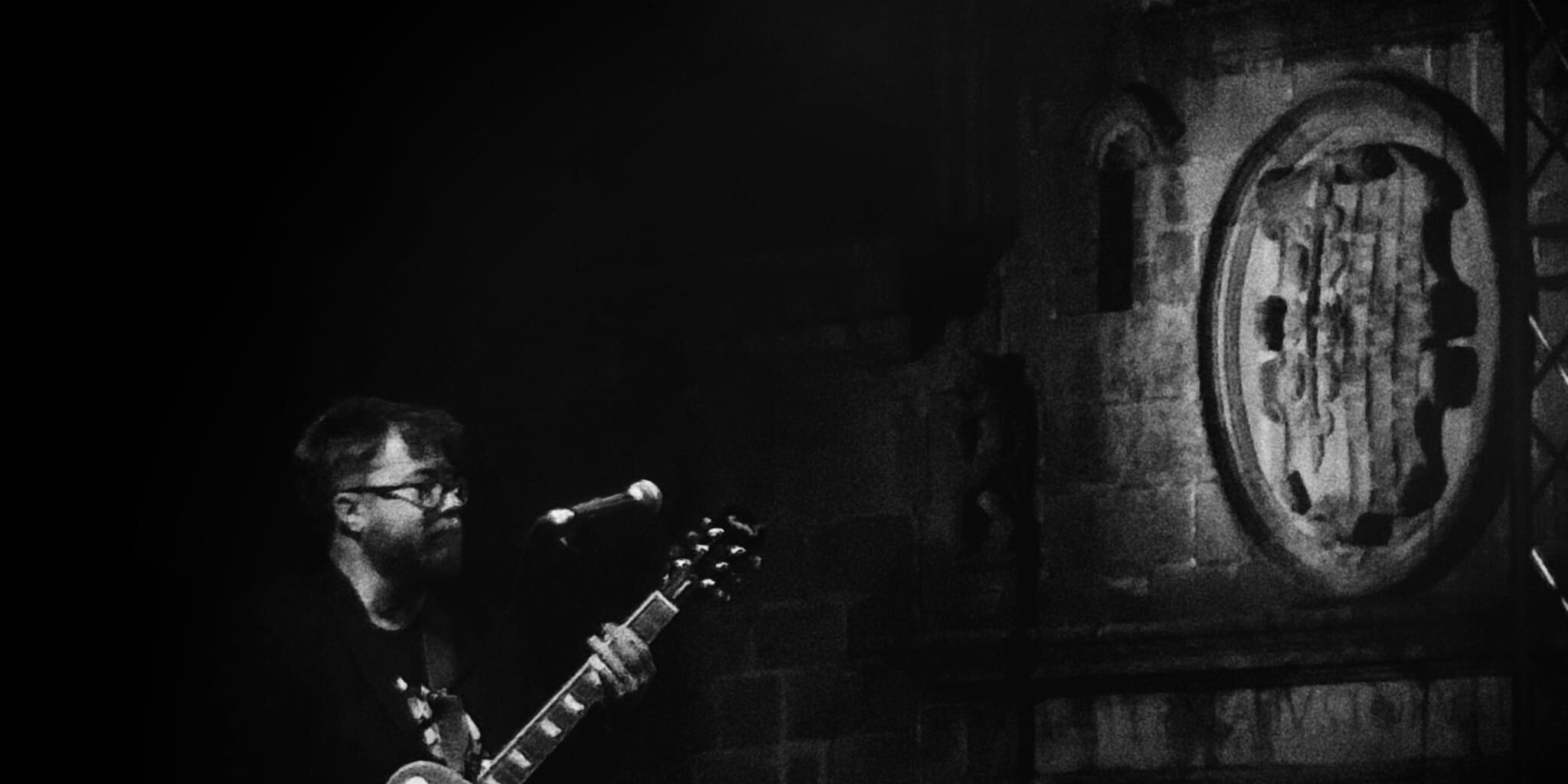
A few months later, I was onstage with Los Eslim at the Cáceres Blues Festival, playing beneath the Renaissance palaces of the old city. West African rhythms had crossed oceans, collided with other cultures, helped produce the Blues, and somehow found their way back to an Extremaduran square.
If that isn’t Transcultura, what is?
My latest Camino a Ítaca column for HOY: music, migration, cultural memory, and our peculiar ability to invent a concept and then fail to recognise it when it turns up with an electric guitar.
(English translation below)
Whose Transcultura?
Night had settled warm and heavy over Korhogo, Cote D’Ivoire when the music found my open window this summer. At first it was only drums, rising from somewhere beyond the hotel walls, insistent enough to make the darkness seem to pulse. Then came the low throb of a bass, the flicker of an electric guitar, keyboards curling around the edges. Above it all rode a woman’s voice: half song, half incantation, repeating and circling, disappearing into the rhythm before rising from it again.
Whatever was happening out there, sleep could wait.
I followed it.
A wedding was underway across the dirt lane. Nobody seemed particularly concerned that a sweaty Canadian had wandered in from the darkness. Quite the opposite. Within minutes I had been welcomed, found a place among the guests and was offered one of the drums. I accepted, although secretly I had my eye on the guitarist.
The bride-to-be was magnificent in an explosion of cloth, color and gold while the singer catalogued her virtues at heroic length. Guests danced forward and pressed banknotes onto her forehead. The groom, meanwhile, watched from the wings, a supporting character at his own wedding.
But it was the music that stayed with me.
Beneath the electric instruments was something much older: polyrhythms piled upon polyrhythms, melodies circling a handful of notes, harmony barely moving at all. It was unmistakably West African and yet strangely familiar.
Perhaps because those sounds have travelled farther than almost any of us.
Across the Atlantic, carried under circumstances too terrible to romanticize, African rhythms and musical ideas encountered European hymns, ballads and instruments. In Cuba, African and Spanish traditions mixed again. The habanera crossed the Caribbean. New Orleans absorbed what Jelly Roll Morton famously called the “Spanish tinge.” Blues begat jazz and rhythm and blues; rhythm and blues helped beget rock and roll. The family tree becomes hopelessly tangled. As family trees usually do.
Last night I stood with Los Eslim on a stage in Cáceres’s Plaza de Santa María for the city’s Blues Festival. Behind us rose the palaces of the monumental city; in front of us, thousands listened to music whose journey has crossed Africa, Europe, the Caribbean and the Americas before somehow arriving back among those stones.
Cáceres 2031 has a word for this: Transcultura. Its candidature speaks of crossing borders, connecting cultures and transforming collectively.
I struggle to imagine a better definition.
Apparently, not everyone sees the Blues Festival as part of that vision. Standing in Santa María last night, it was difficult to understand why.
There it was: African rhythm in an Extremaduran square; the pentatonic ghosts of the Sahel inside electric guitars; Europe and America answering one another across centuries. And all of it free, in the street, before people who didn’t need to know where the music came from to recognize something in it.
Culture cannot survive in aspic. It migrates, borrows, steals, remembers, forgets and comes home wearing somebody else’s hat. What we eventually call tradition is often merely a mixture that has been around long enough for us to forget the mixing.
The stones surrounding the square suggest permanence. The music tells another story.
Somewhere along the journey, somebody always joins the band.