My God Can Beat Up Your God
…that’s the childish logic at the heart of a great deal of very adult violence.
In this piece, I examine how quickly geopolitical conflict gets reframed as a moral—or even theological—contest, and how easily people who would reject certain ideas at home find ways to defend them abroad.
What interests me is not just the argument itself, but the strange intellectual flexibility that makes it possible.
It’s not a comfortable line of thought. Nor is it meant to be.
Read my latest Camino a Ítaca piece in Spanish in the HOY (without paywall on this one) 👉 https://www.hoy.es/opinion/troy-nahumko-dios-puede-darle-paliza-tuyo-20260404180758-nt.html
Or the English translation below.
My God Can Beat Up Your God
Let us begin with an admission nobody on the righteous side of this latest geopolitical adventure seems willing to make: nobody’s god is great. Not that of the turbaned tribunal adjudicating hemlines in Tehran, and not the one whose authorized representatives cannot quite decide whether women are full human beings or a pleasingly subordinate category thereof. The sooner this theological baseline is established, the sooner we can examine the spectacular intellectual contortions that began the moment the bombs started falling.
Because as soon as the munitions found their targets, a miracle occurred in the op-ed pages of the Western right. A movement that spent decades insisting feminism was a Marxist plot suddenly discovered—like a televangelist struck by revelation—that it had always been fighting for the sisterhood.
The bombs meant freedom.
Each explosion, they insisted, shattered another chain binding Iranian women. Each crater was, in the squinting light of ideological necessity, a blow struck for liberation. One pundit even celebrated the killing of schoolgirls on the grounds that a crater was preferable to a veil. One imagines the girls might have had thoughts on the matter—but the opinions of actual women have rarely been central to projects designed to liberate them.
These newly minted champions of feminism, it must be noted, largely profess to traditions that will not permit a woman to stand at the altar and preach with authority. Their scriptures advise women to remain silent in church, to submit to husbands, and to refrain from exercising authority over men. These are not obscure footnotes. They are load-bearing walls.
Yet their god, they assure us, is the feminist god.
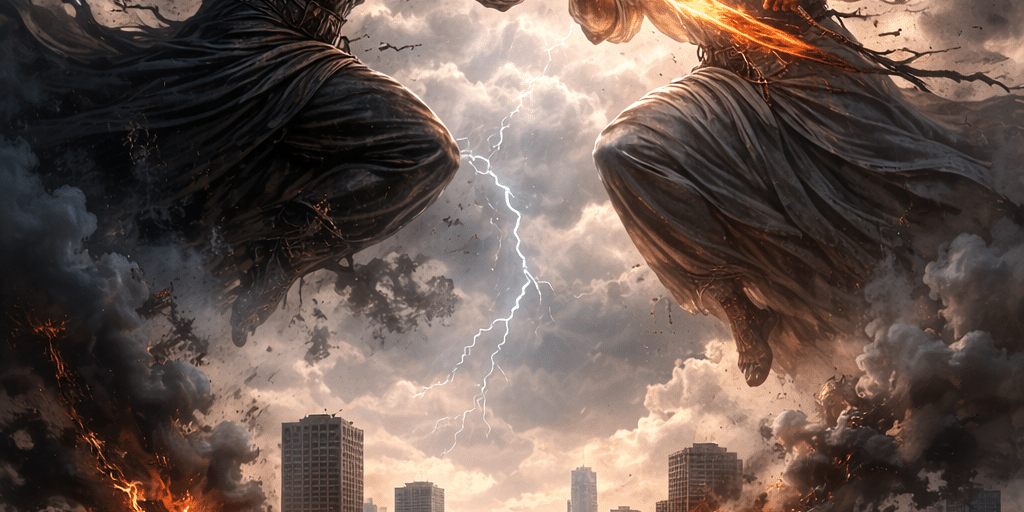
Strip away the incense and the argument reveals itself in its childish glory: my god can beat up your god. Their Bronze Age patriarch is barbaric; ours is… merely traditional. Their holy book is oppressive; ours is…misinterpreted. It is the theological equivalent of two eight-year-olds arguing over whose father would win in a playground fistfight, except the fathers are invisible and the fistfight involves cruise missiles.
Naturally, this story requires some convenient historical amnesia. The Enlightenment—that awkward period during which Western societies began clawing their way out from under clerical authority—must be quietly removed from the narrative. Every freedom Western women actually possess—the vote, divorce, contraception, protection from a husband’s violence—was achieved in direct confrontation with religious institutions quoting scripture in opposition.
Which brings us to a small arithmetic reckoning.
You, the committed Christian conservative, already disbelieve in nine thousand nine hundred and ninety-nine gods. Zeus, Thor, Ra, Baal, and an entire celestial graveyard of deities whose temples now host guided tours. You navigate this without existential crisis.
Nonbelievers simply take this skepticism one god further.
If there is any lesson to be drawn from the spectacle of bombs marketed as feminism, it is this: the women of Iran do not need liberating into a rival superstition. They need what all women need—the freedom to think without a deity’s appointed male interpreters dictating the conclusions.
Freedom was built by arguing against celestial whims, not by dropping bombs in its name.
But consistency was never the point. There is a war on, and wars require justifications. Feminism makes a fine flag to wave on the way to the target coordinates.
After all, it is much easier to liberate women from the air.