The Coming Cultural Revolution of Extremadura (No, Not That Kind)
There’s a certain kind of art that appears whenever politics gets too involved in culture.
It’s grand, symbolic, completely certain of itself — and often, unintentionally, a bit absurd.
You see it in Stalinist skylines, Soviet statues, gold-plated presidential monuments. Different countries, same instinct: culture not as something messy and alive, but something to simplify, package, and display.
Which makes the current moment in Cáceres worth paying attention to.
As a finalist for European Capital of Culture 2031, Cáceres represents exactly the kind of deep, layered cultural history Europe likes to celebrate. At the same time, cultural policy in Extremadura is increasingly shaped by an alliance between the PP and the far-right tinfoil hats.
The tension between those two things is the subject of the piece below.
Original Spanish column (HOY) here and English translation follow.
—————————-
I’ve always had a secret fetish. No, nothing scandalous — nothing you’d need to clear your browser history over. Something more personal, more embarrassing. I’ve always had a thing for certain forms of totalitarian art.
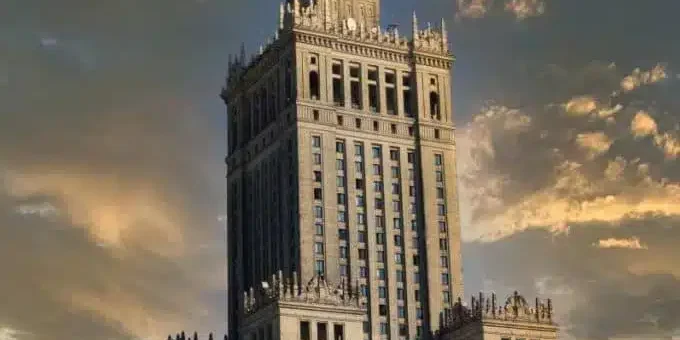
I remember seeing Stalin’s ‘Gift to the People’ skyscraper in Warsaw for the first time and falling immediately, helplessly in love with its horrendousness. The very name leaps from comic-book villain archetypes. The secrets that must have happened inside.
I confess genuine sadness whenever I hear about movements to demolish it, not because I’m soft on Stalinism, but because tearing it down implies we’ve learned something, which seems optimistic.
The gargantuan neorealist sculpture scattered across the former Soviet Union affects me similarly: those enormous muscular workers, fists raised toward a horizon of collective liberation, built by a state simultaneously working those same workers to death in Siberia. The cognitive dissonance alone deserves a preservation order.
I have not yet made it to Turkmenistan’s gold-plated rotating statue of the first president, which rotated with the sun so that Turkmenbashi was always, in some sense, facing you. Nor to North Korea’s operatic unreality. I intend to remedy both before I’m finished.
Here in Spain, though, I have always felt cheated. Other dictatorships got Wagnerian marches and architectural megalomania. We got squat granite crosses. That’s it. The full creative vision. Not even a new idea — just a cross, the single most reproduced image in two thousand years of Western civilisation, rendered in granite by men who apparently surveyed the entire iconographic inheritance of fascism and concluded: no, a cross, but uglier.
So now the far-right once again caresses the levers of power here in Extremadura — fingers barely grazing them, let us be fair, not yet gripping.
And Cáceres, rather astonishingly, has reached the final round of candidacies for the 2031 European Capital of Culture. Which raises a question of some urgency: what exactly is the cultural vision here?
The question answers itself, historically. Every authoritarian project in history has had an interesting relationship with culture, by which I mean it has loved culture’s costumes while finding culture’s actual personality intolerable. Genuine culture — the awkward kind, the kind that asks questions nobody authorized, that sits with ambiguity, that represents people the state would rather weren’t represented — that culture tends to find itself defunded or worse, imprisoned. What replaces it is the simulacrum: grand, legible art in which the purpose is always the same, whether the flag is red or black or, in this case, the particular shade of beige that Spanish conservatism favors.
The tragedy is that Extremadura contains genuine, astonishing culture. Roman theaters. Islamic architecture. Medieval everything. A landscape that looks like God was showing off. None of this requires a government with authoritarian instincts to make it interesting. Indeed, the arrival of such a regime is the first genuinely threatening thing to happen to it in some time.
But perhaps I’m being uncharitable. Perhaps Cáceres 2031 will produce something so magnificently tone-deaf, so catastrophically misconceived — some monument so perfectly expressive of its own ideological bankruptcy — that future generations will make pilgrimages to stand before it in appalled reverence, the way I stood in Warsaw.
Culture, after all, has a long memory. And sometimes the most enduring art is the kind nobody intended to make.