The Iran We Think We Know — and the Iran We Don’t See
How do you understand a country that seems to contain at least two entirely different worlds?
In my latest Camino a Ítaca column in the Spanish newspaper HOY, I explore a paradox I witnessed while thinking about modern Iran. In Tehran, a one-hour drive can feel like a journey across centuries — from affluent northern neighbourhoods that resemble a cosmopolitan future to poorer southern districts where life still moves at a far slower pace.
The divide is not simply religious versus secular, nor tradition versus modernity. It is something older and more universal: the gulf between those who live comfortably at the top and those struggling at the bottom. Iran’s revolution, like others before it, lifted millions out of poverty through systems built around faith and social welfare. Yet those same structures can also trap the people they once helped.
It is a story not only about Iran, but about the strange paradox of revolutions everywhere — systems that promise (some) dignity and deliver it, but at the price of freedom.
The column was published in Spanish in HOY as part of my bi-weekly column Camino a Ítaca.
📖 You can read the Spanish version in the newspaper here, or continue below for the full English version of the essay.
The Iran the West Does Not See
Troy Nahumko
Time travel requires no machine in Tehran. An hour’s car ride — depending on traffic, and in Tehran there is always traffic — is all it takes. In the space of sixty minutes, you can move from something resembling the near future to a world in which a mule is still the most reliable form of transport. You drop from the smog-free heights of the snow-capped Alborz, a thousand metres above the salt plain, and the descent can feel like a thousand years compressed into a single morning.
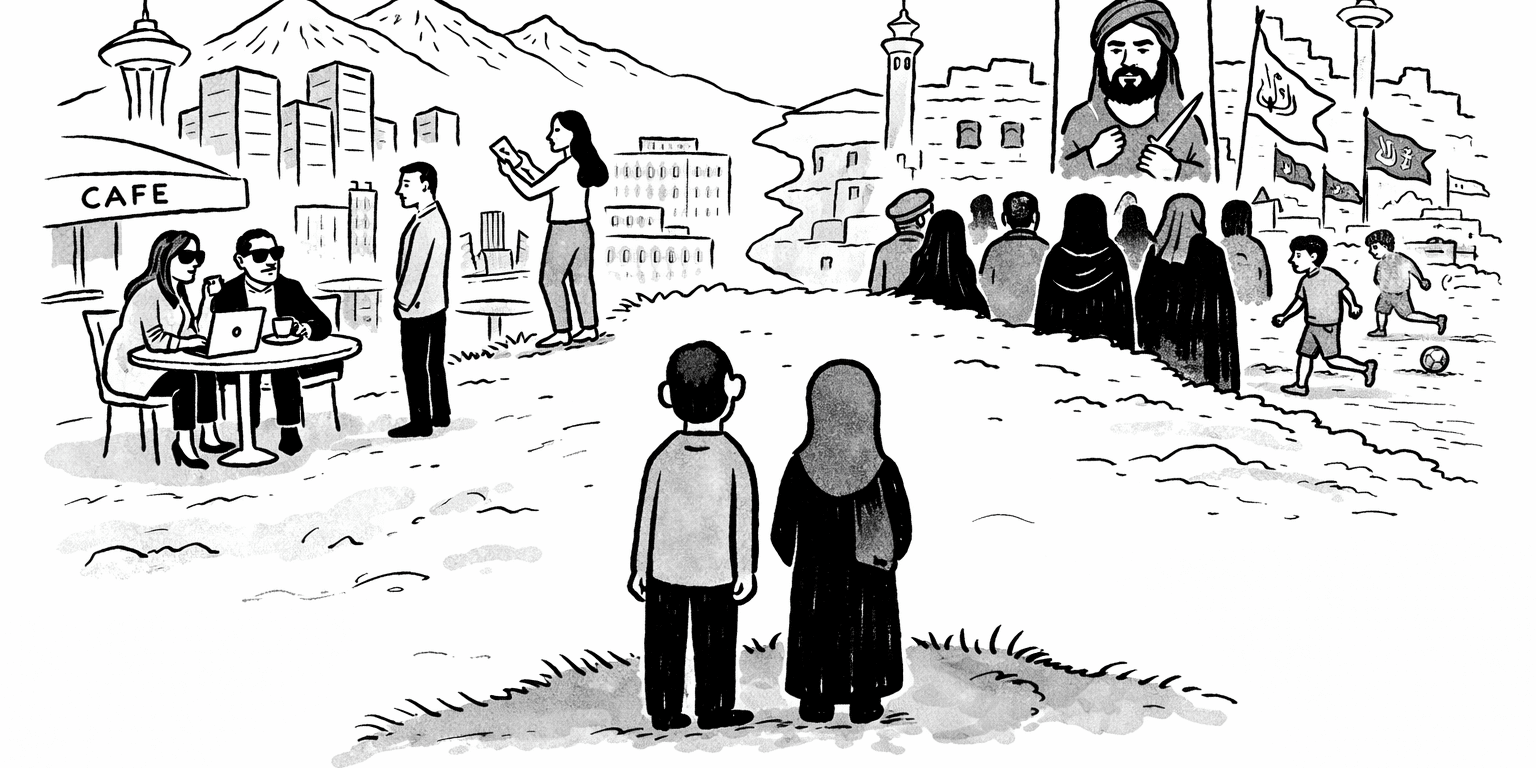
Two very distinct cries rose up across the Iranian capital last Saturday. In the affluent north, among the glass-faced apartment towers and the coffee shops where young women with loosened veils tap at laptops, there were cries of joy. Death to the tyrant. For those who lived this version of Iran — educated, wired, secular in aspiration if not always in practice — the theocratic nightmare they have endured felt, for one brief morning, one step closer to its end.
Yet in the impoverished south, along dusty lanes where children kick improvised footballs through shadows of unfinished concrete, another sound rose. Not joy. The ancient, fathomless wail of Shia martyrdom—that grief which hasn’t healed since Karbala in 680 AD, when Imam Hussein, grandson of the Prophet, was slaughtered, and the faithful were wounded so deeply they bleed still, fourteen centuries on.
This is the essential paradox of modern Iran, and perhaps of the modern world: the divide is not necessarily, at its root, between the secular and the devout, the Westward-looking and the traditionally rooted. It is something older and cruder than ideology. It is vertical. It is the ancient, universal chasm between those who live at the top and those condemned to the bottom.
Here lies Iran’s tragedy: the Revolution kept its promise, after a fashion. The clerics brought electricity, literacy and clinics to villages that had known only dust and dysentery. The mostazafin—the oppressed—were lifted from abject poverty by the very theology that now holds them captive. The mosque became welfare office, school, bank, court… Faith was mobilised as social infrastructure, and it worked. But it worked too well. The ladder that raised them became the bars of their cell.
Compare Cuba—another revolutionary state that traded freedom for rice and vaccines. There too, the secular saints delivered dignity to the destitute, then confiscated their future. Both regimes understood that poverty breeds piety, whether to God or to the patria. Both constructed systems where survival depends on submission. The difference is theological: where Castro offered material salvation, Khomeini offered eternal life.
In the West we mistook Saturday’s northern jubilation on the surface for the whole. The south did not celebrate because the south has little reason to believe in this republic’s fall—only in the next world’s justice. The wail is not merely mourning; it is resistance of a kind the secular mind struggles to parse. To grieve Hussein is to rehearse opposition to tyranny, yet to bind oneself to a hierarchy of suffering that legitimizes present pain as spiritual currency.
So Tehran remains bifurcated: north and south, those who would flee the prison and those who have learned to love its walls. And somewhere in that descent, between snow and dust, Iran remains suspended—liberated by faith, incarcerated by it, waiting for a cry that might, at last, unite the mountain and the plain in one voice.