How Did It Get So Late So Soon?
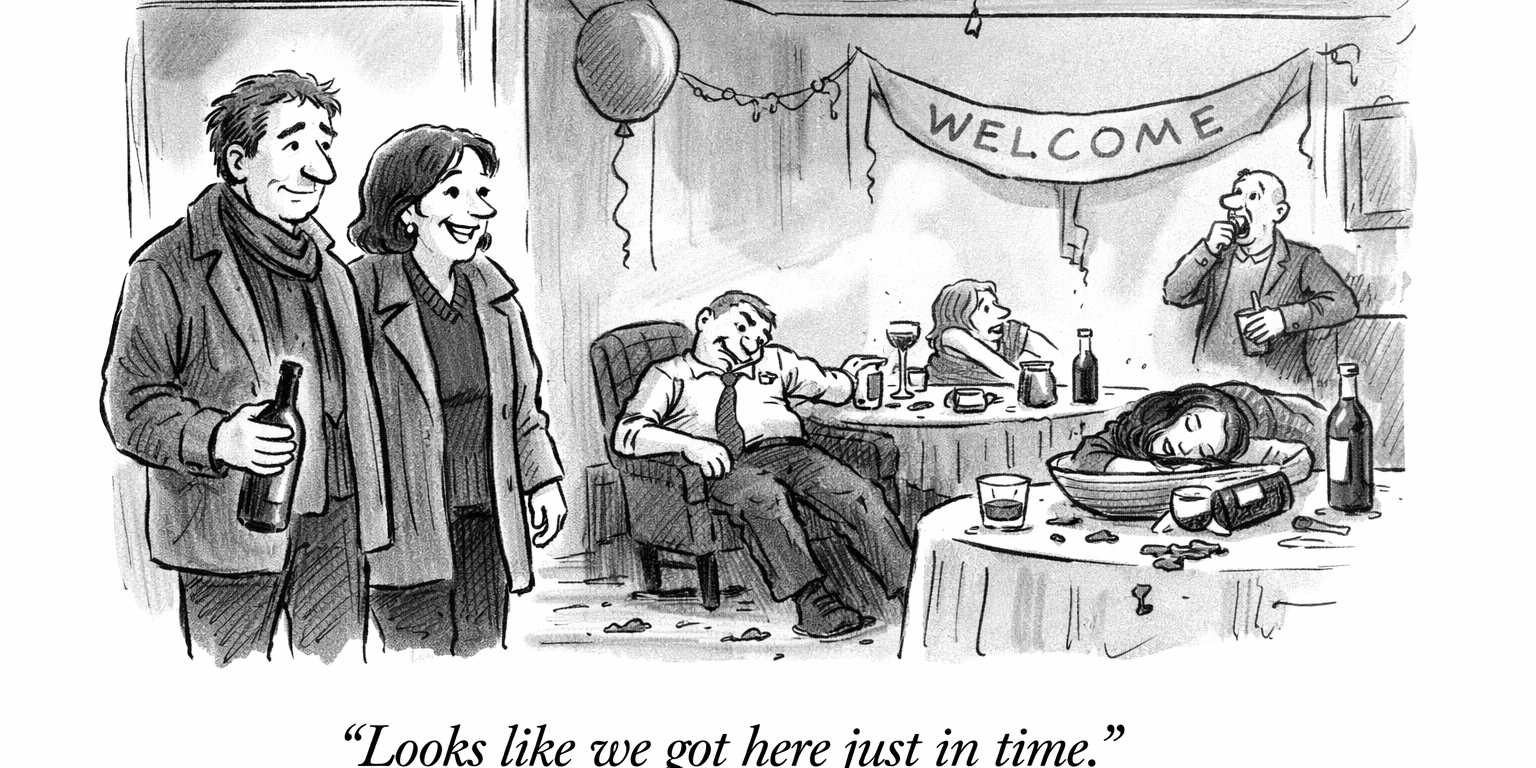
There’s a particular kind of pride that comes from arriving late to something and still acting as if you’ve nailed the timing. You missed the drinks, the good conversation, and whatever fleeting moment of relevance the whole thing once had—but at least you showed up with confidence. And really, isn’t that what matters?
Extremadura, in its own quietly remarkable way, has perfected this art.
At a moment when much of the Western world is beginning—tentatively, awkwardly—to reassess its brief but intense flirtation with authoritarian strongmen, we’ve decided this might be exactly the right time to double down. Not enthusiastically, perhaps. Not even consciously. But effectively? Absolutely.
The result is one of those political outcomes that manages to be both surprising and entirely predictable. The kind where everyone involved can point to their own logic, their own strategy, their own justification—and yet the end product looks suspiciously like the opposite of what was intended.
Funny how that keeps happening.
In today’s column for HOY (Camino a Ítaca), I try to unpack how we got here: the timing, the miscalculations, the strange disconnect between reality and perception, and the enduring appeal of narratives that bear only a passing resemblance to the world we actually live in.
It’s about elections, yes. But also about something broader: how regions, like people, can find themselves slightly out of sync with the moment—and how long it takes to notice.
If you read Spanish, you can find the original column here:
👉 https://archive.ph/g5qY9
And if not, I’ve posted an English translation below (slightly longer and more unraveled):
_________________________________________________
It is never ideal arriving late to a party. Shakespeare once wrote that it was better to be three hours too soon than a minute too late. You get there and the good canapés are long gone, the ice reduced to sad puddles, the conversation already past interesting and deep into the slurred and maudlin. And yet here we are, Extremadura, shuffling in through the door at quarter to never, coats still on, blinking in confusion, cheerfully oblivious to the fact that the party wrapped up some time ago and the hosts are already regretting everything.
Because as the western world’s sordid little flirtation with authoritarianism shows unmistakable signs of souring, our president — María Guardiola, a woman of truly impeccable timing — called a snap election at precisely the wrong moment, apparently calculating that the electorate would reward her for being held hostage by Vox rather than simply electing more of them.
That worked well…
Vox doubled its seats, from five to eleven, and now holds the keys to the Junta once again, only this time from a position of considerably greater smugness. Santiago Abascal declared Óscar Fernández the “real winner” of elections his party came third in — and in the surreal theatre of contemporary Spanish politics, he was not entirely wrong.
One is reminded of the person who, after years of agonised deliberation, finally commits to buying the bell-bottoms — only to discover they went out of fashion, came back briefly, went out again, and were, on reflection, always slightly ridiculous. Guardiola herself once declared that she could not allow into her government those who “deny gender-based violence, dehumanise immigrants, and throw the LGBTI flag into a bin.” Then she allowed them in. Then they blew up the government over migrant children — those not in a manger. Then she called elections to be free of them. Then the voters sent back twice as many of them. There is a Samuel Beckett quality to this that might be charming were it not for the people it will affect.
Meanwhile the wider world, with characteristic indifference to our scheduling difficulties, has been moving on. Hungary — Hungary, of all places — found the democratic silver bullet to democratically remove the EU’s most accomplished institutional saboteur, against all odds and against every guardrail Orbán spent sixteen years quietly dismantling. The very week Extremadura was voting Vox to new heights, Hungarian Conservative — Orbán’s own propaganda organ — was excitedly reporting the good news from our dehesas. One imagines the editorial meeting the following morning was somewhat more subdued. Even across the Atlantic, the MAGA faithful are beginning to check the receipt — and discovering that the golden toilet they were sold is, on closer inspection, painted chipboard, and the snakeoil salesman who pawned it off on them has already moved on to the next mark.
But not us. Not yet. In this land seemingly condemned to spectacular, uncreative belatedness — governed by people who appear to receive the international news cycle with the delay of a slow boat — we are only just getting started. We are a region where 4.4% of the population is foreign-born, where Vox has just delivered its strongest regional performance by warning voters about the catastrophic threat of immigration. Reality, it turns out, is largely optional. Perception is the product, and the product is selling.
The reckoning will come. It always does. Once they have extracted what they can, rolled back the environmental protections — already under pressure in a region where the dehesa and the Tagus demand rather more care than ideological posturing provides — and installed their bronze-age certainties into institutions built for something better, the gap between the promise and the reality will become difficult to ignore, even for the most committed.
There is one final saying worth recalling, appropriate for a region with our complicated relationship with punctuality: better late than never. Because if those now tightening their grip on the Junta had their way in perpetuity — if they could arrange things entirely to their satisfaction — “never” is precisely when the next free choice would arrive. That is not a metaphor. That is the stated preference of every movement like this one, everywhere it has ever taken hold. The only open question is whether we will notice before or after the bill comes due.