Fear and Faith in a Roundabout in Cáceres
A new long-form essay published in El Salto Diario Extremadura traces an unlikely line from the Pentagon to a roundabout in Cáceres.
Beginning with the spectacle of religion in contemporary American politics — where faith, media, and military power increasingly blur — the piece follows a broader transformation: Christianity repurposed as political identity, its symbols stripped of meaning and redeployed as markers of belonging and tools of conflict.
This sordid trajectory arrives in Extremadura, at the site of a Francoist cross standing where a Republican fountain once was. Today, it has become the center of a renewed cultural and political battle, raising questions about memory, history, and what exactly is being defended.
At its core, the essay explores how symbols endure, how they are reshaped over time, and how local conflicts often reflect much larger global shifts.
Read the full piece (in Spanish) here:
👉 https://www.elsaltodiario.com/extremadura-/miedo-fe-rotonda-caceres
An English translation follows below.
Fear and Faith in Roundabout in Cáceres, Spain
The man at the podium had hair like a televangelist who’d discovered steroids. Slicked back. Lacquered. Weaponized. The suit cost more than a Humvee and fit like righteous purpose had been tailored around his shoulders. His eyes contained the particular vehemence of a man who has recently discovered God and, between swigs from his hip flask, hasn’t yet ruled out the possibility that God discovered him first.
We are in the Pentagon. Or what used to be the Pentagon, until somebody in MAGA-world realized that the National Geospatial-Intelligence Agency’s old Virginia campus made for a more spiritually flexible venue. The world’s erstwhile largest office building — seventeen miles of corridors, thirty thousand souls processing the machinery of American consequence — now hosting a prayer meeting. This is either the most natural thing in the world or the most insane, and by the time the fever takes hold, the distinction has stopped mattering.
The nation was at war. American service personnel had been returned to their families in flag-draped boxes, courtesy of a conflict that had started when somebody else’s god gave somebody else’s government a green light in a region where green lights have historically been a prelude to catastrophe. The weight of it hung over the room like cordite and Old Testament prophecy, which — when you consider the theology at play — might be the same thing.
And then — God help us, and He will not — Pete Hegseth began to speak.
He’d been rebranded by this point. The Fox News chyron updated, the business cards reprinted. “Secretary of Defense” had the musty ring of the Geneva Convention about it, the brackish smell of institutional restraint. Secretary of War had the honest clarity of a man who’d finally stopped hiding the merchandise. And standing there before an audience of uniformed personnel — soldiers, sailors, airmen, marines, all of them oath-sworn to a Constitution containing, if you read it at the right angle, a rather pointed clause about state religion — the Secretary of War opened his mouth.
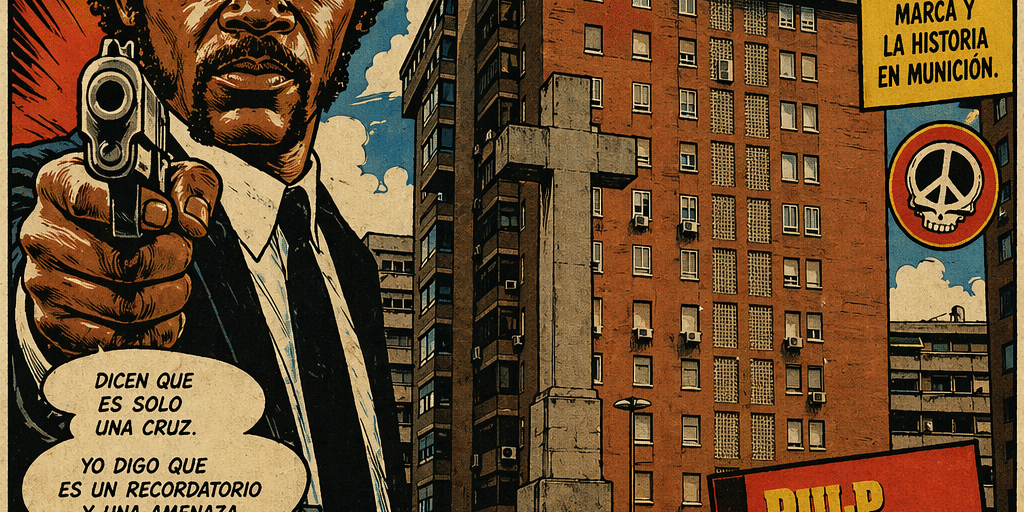
What came out was not exactly the words of a tattooed white supremacist, but those of the very black Samuel L. Jackson.
Well, not literally. But the passage — the passage — arrived with the full freight of Ezekiel 25:17 as reimagined by Quentin Tarantino, delivered by a man who had confused Pulp Fiction with the Book of Revelation. “The path of the righteous man,” intoned the Secretary, and something cracked open in the room, some membrane between the sacred and the cosmically absurd, and through that crack poured everything that has been festering in the Christianity of America, and by extension, the world.
Because this — this prayer meeting in a building designed for the organized projection of lethal force, this man invoking cinematic scripture at a military congregation on behalf of a foreign war, the Holy Spirit apparently having cleared his deployment orders through the relevant combatant command — this was not your grandfather’s Christianity. It was not your Pope’s Christianity. It was not even the Christianity of Aquinas or Augustine or the earnest men in Geneva arguing about grace in cold rooms. It was something that had broken off from the main body of the faith the way tectonic plates break, slowly, then all at once, and was now grinding against two thousand years of tradition with the cheerful confidence of a man who has never been asked to justify himself to anyone who outranked him.
Henry VIII, that sweaty, magnificent bastard, had needed a divorce and an Act of Parliament. All he’d managed to split was England from Rome.
These people were going for the whole thing.
But let us pause and consider the man who sent Hegseth. The man upstairs. The landlord of the whole operation.
Because while his Secretary of War was channeling Tarantino to a captive congregation, the twice-impeached, four-times-indicted, once-convicted current occupant of the White House was on his social media platform, the one that functions as a direct neural link between his id and his flock, posting images of himself as the Christian savior.
Not adjacent to Jesus. Not inspired by Jesus. As Jesus. The golden light. The crown of thorns rendered in MAGA aesthetic. AI-generated hagiography for a man who has, by credible documented account, never once attended a church service he wasn’t photographed at, never once held a Bible he wasn’t using as a prop, never once demonstrated any familiarity with its contents beyond its utility as a rectangular object that signals tribal membership to people standing too far away to read the cover.
And his base, God love them, God weep for them, lapped it up. Shared it. Printed it on t-shirts. Hung it in living rooms next to their white felt Jesus, the one from Nazareth, the one with rather pointed things to say about the rich, the powerful, and those who make a performance of public piety while privately treating the poor as furniture.
There is a particular species of contempt that requires intimacy to sustain itself. You cannot despise strangers with real efficiency. But the people you have studied, whose psychology you have mapped, whose fears you have catalogued, whose faith you have measured and found useful — those people you can despise with the focused precision of a laser. This is a man with a doctoral-level understanding of exactly how much you can extract from someone who has been told that suffering is holy.
He knows that the faithful will look at the Jesus pictures and feel not sacrilege but warmth. Because the alternative is to conclude they have been played. And the mind — that magnificent self-protecting organism — will construct any narrative, scale any theological mountain, perform any feat of interpretive gymnastics rather than arrive at the conclusion that the man they gave their votes and their tithes and their identity to has been, from the very first handshake, laughing at them from the back of his limousine.
This is the system. Not stupidity — stupidity is accidental. This is the logical endpoint of a project decades in the making: the complete capture of Christian identity as a political brand, severed from Christian content, policed at its borders by the accusation of bad faith. The cross on the lapel pin. The prayer before the press conference. The vague spiritual energy that tells the base these are their people.
The content of the faith — the Beatitudes, the corporal works of mercy, the camel and the eye of the needle, the radical, economically inconvenient insistence that the last shall be first — that content is not the product. That content is a liability. That content is what the Pope keeps bringing up.
Then God, Zeus, the universe — that deranged improvisational comedian — decided to raise the stakes.
The red Argentinian Pope died. And the College of Cardinals, locked in the Sistine Chapel with their ballots and their ancient ritual, looked across the Atlantic at the smoking ruin of American Christianity — at pedophilia bankruptcies, the Jesus selfies, the Pentagon prayer meetings, the Secretary of War doing Tarantino for soldiers — and elected an American Pope.
A South Sider. A White Sox fan. A boy from Dolton, Illinois who had grown up playing priest in his family’s basement, distributing candy wafers to his brothers as communion when he wasn’t pretending to be one of the Blues Brothers. A man of faith who had then spent decades as a missionary in Peru before the Cardinals, in their infinite and apparently mischievous wisdom, decided that the 267th successor to Peter should be Robert Francis Prevost. Now Leo XIV.
The universe apparently has a sense of humor.
Consider the geometry of this. The man posting AI halos of himself now had to contend with a Pope without an accent. A Pope who couldn’t be dismissed as a communist shill from Buenos Aires. An American Pope. His American. Born forty minutes from one of his golf courses, give or take the vast moral distance between Dolton and Mar-a-Lago.
King Cheeto responded with characteristic theological precision. He informed the world via Truth Social that he could not abide a Pope who criticized the President of the United States. He accused Leo of being — one must let this breathe — “WEAK on Crime, and terrible for Foreign Policy.” He suggested Leo would not even be Pope had he not been re-elected. The Vicar of Christ, in other words, owed him one.
Then he reposted the Jesus image. The same day. Himself: golden, luminous, the crown of thorns conveying not suffering but dominance, the way everything he touches conveys not meaning but dominance. When confronted, he claimed he thought it was a picture of himself as a doctor. He deleted it. Then posted another — Jesus embracing his girth, caption implying the Almighty had weighed His options and gone MAGA. The Sermon on the Mount, presumably, was being revised. Blessed are the ratings-havers.
Meanwhile Hegseth was explaining to reporters that a recent rescue operation in Iran had unfolded across Good Friday, Holy Saturday, and Easter Sunday, and therefore God had clearly pre-approved the airstrike. “A pilot reborn,” he said. “God is good.”
Ten thousand miles from the Pentagon, among the poorest in Cameroon, Leo XIV heard this and deployed the word the prophets reserved for cities that were about to have a very bad time.
“Woe to those who manipulate religion and the very name of God for their own military, economic, and political gain, dragging that which is sacred into darkness and filth.”
When asked about the administration’s belligerent response, the Pope said simply: “I have no fear of them.”
JD Vance — Catholic convert, self-described baby Catholic, a man who found Jesus sometime after he found Peter Thiel’s money — told the Pope to stay out of politics and concentrate on morality. The Vice President of the United States. Instructing the Pope. On morality. The specific morality the Pope was permitted to address. All this while the administration he serves deports refugees, bombs Iran, and generates AI images of its leader as the Messiah.
Leo, standing in that Cameroonian cathedral, put it with the patience of a man who has been waiting for exactly this moment: “The masters of war pretend not to know that it takes only a moment to destroy, yet often a lifetime is not enough to rebuild.”
Henry VIII broke with Rome because Rome wouldn’t give him what he wanted.
These men are attempting something more ambitious. They are trying to become Rome. To replace the content with the aesthetic. To wear the cross without accepting the weight.
Rome had answered.
From Chicago.
The schism, like all good apocalypses, is not solely American. It has gone fully international — franchised out like a fast-food theology, adapted for local markets while maintaining the same essential ingredients: a cross repurposed as a weapon, a poor person repurposed as a threat, a billionaire repurposed as evidence of divine favor.
Like McDonald’s, this new religiosity has found fertile ground here in Spain.
España. The country of Torquemada and Teresa of Ávila, of the Inquisition and the mystics and the Monty Python sketches, of cathedrals so extravagantly beautiful they constitute an argument for the existence of God regardless of your priors. A country that spent forty years under a theocratic dictatorship called National Catholicism that fused the cross and the sword so thoroughly that it has taken half a century of democracy to pry them apart — and may not have finished the job.
Because here, in this supposedly secular kingdom, the same theological mutation is spreading. With a specifically Spanish flavor — more wine than whisky, more Opus Dei than Oral Roberts — but arriving at the same destination by a different route.
The regime nostalgics — and there are considerably more of them than the liberal consensus finds comfortable to admit — have been watching Leo XIV with the displeasure of people who considered the institution theirs and are finding it once again occupied by the wrong agenda. The Sermon on the Mount, in their reading, is distinctly communist and they had had enough with Bergolio, who they thought was simply a Marxist in a cassock. To them, the bits about the camel and the needle are metaphorical at best. Render unto Caesar means, upon careful re-examination, that billionaires are Caesar and their tax arrangements are therefore sacred. The migrants crossing the Strait of Gibraltar from the Africa that Spain and the rest of Europe have spent centuries extracting wealth from are the appropriate object of the fear and resentment that the Gospel, in some less careful readings, apparently authorizes.
They have done what power structures have been doing to inconvenient scripture for two millennia: read around it, read through it, read it at an angle until it says what they need it to say. The difference is the speed and confidence of it now. The total absence of embarrassment. The sense that the hermeneutical gymnastics no longer need to be concealed because their team is winning and the Pope — even this Pope, even the American one with the White Sox hat and the genteel manner — can be dismissed as political.
The Spanish far right has even gone so far as to accuse the Church of profiting from caring for migrants. A thing that not even the most ferocious anti-clerical pundit in Spanish history would have confidently said in public. They have thrown their lot in not with the man in Rome but gone straight to the source, pitching their tents next to the genocidal leader in Jerusalem who claims to have a land deed to the greater middle east from the man above signed in their enemies’ blood.
And then there is Isabel Díaz Ayuso.
President of the Community of Madrid. The woman who turned the Puerta del Sol into a temple of libertarian provocation, whose political brand is essentially freedom — specifically the freedom to have a beer on a terrace, to send your children to a subsidized private school, to pay less tax than your neighbors in Catalonia, and to be loudly, performatively Spanish in ways that make a certain kind of person feel that civilization itself is being defended.
She was, depending on which account you credit, agnostic. Perhaps atheist. A child of the secular transition generation, shaped more by all night clubs of the movida than by the confessionals of its churches.
And then the wind changed.
Ayuso has found faith. A very modern faith. One that exists not in the incense-cloyed magnificence of the Almudena, not in Toledo’s synagogue-turned-mosque-turned-churches that summarizes eight centuries of contested sacred space, not in the Romanesque hermitages in the sierras and plains where the actual Christian tradition of Castile was built stone by stone by people whose theology was inseparable from their poverty.
No. Ayuso’s faith lives on the Calle Serrano. In the glass-fronted think tanks and the podcasts and the political theology of the new theological libertarians — the ones who have revealed that God is, after all, a free marketeer. That the invisible hand and the hand of Providence are, upon reflection, the same hand. That the Gospels, read correctly, which is to say, read in the specific way that does not disturb the Ibex 35, are a remarkably robust defense of low corporate taxation and deportation policy.
It is the new MAGA faith, translated. The same fundamental move — Christianity as identity, as flag, as civilizational team jersey — performed in Castilian, with better tailoring and a reference to the Reconquista where the American version would wrongly reference the Founding Fathers. The cosmetics differ. The cynical contempt is identical.
Contempt for the neighborhood priests who take the social teaching seriously. Contempt for the Caritas volunteers in Lavapiés doing what the Sermon on the Mount, taken at face value, actually instructs. Contempt, above all, for their own faithful base — the genuinely devout filling pews in the working-class parishes of Vallecas and Carabanchel, who light votive candles for their dead and believe, with the simple integrity of people who know no alternative, that the Church as an institution means what it says.
These people are useful. Their votes count the same as everyone else’s. Their identity as Catholics provides the civilizational framing that makes the whole project legible.
Their actual faith — with some of its inconvenient demands, its economic implications, its insistence that the stranger at the gate is Christ in disguise — that part can wait.
That part has always been able to wait.
That is the oldest trick in the history of institutional Christianity, and the new theological libertarians of the Pentagon and the Calles Bambu and Genova did not invent it. They have merely — and here is where the scale of the rupture becomes fully visible — stopped pretending they’re not doing it.
The mask isn’t slipping. They’ve decided they don’t need one.
Which brings us, in the end, to a roundabout in Cáceres.
Not metaphorically. An actual roundabout, with traffic and exhaust and people trying to get to the supermarket while history screams quietly from the center island. A crossroads in Cáceres — a city of such accumulated historical sediment, such geological layers of conquest and reconquest, Romans and Visigoths and Moors and a UNESCO listing, that adding one more symbol to the pile might seem redundant. It is not redundant. Nothing in this city is redundant. Everything means something. That is the problem.
The cross in question is twelve and a half meters tall, with arms of three meters. It was built in 1937, while the Civil War was still being decided in blood, approved by municipal decree on September 9th of that year as a monument to honor the fallen of the bando sublevado — the insurgent side, Franco’s side, the side that had just finished shooting a substantial portion of its own citizenry for the crime of voting incorrectly. It was one of the first of its kind in Spain. They were in a hurry.
But before the cross, there was a fountain.
On the spot where the cross now stands, there had been the Fuente del Lápiz, known affectionately to Cacereños as La Palmatoria, built in 1934, during the Second Republic. A public fountain. A civic object. The kind of thing a functioning democracy puts in its public squares for no reason more ideological than that people get thirsty and cities should be pleasant.
The Francoists tore it out. Not metaphorically. With tools. With intent. They demolished the Republican fountain and raised, in its precise location, this twelve-meter cross. The act was not incidental. It was the point. Sustitución ideológica — ideological substitution — was the operating principle of the entire regime’s relationship to public space, and this was the thing itself, performed in stone and concrete on a crossroads in Extremadura while the war was still warm. It was a reminder and a warning.
And then they inaugurated it. Pilar Primo de Rivera, head of the Falange’s women’s section, arrived in May 1938 and stayed four days. Before her, according to the enthusiastic press of the epoch, paraded fifteen thousand soldiers and three hundred flags. A thousand doves were released. The bishop of the diocese attended. Children sang. A gala performance was held afterward at the Gran Teatro. Flag oaths were sworn at its base. First communions were offered at its foot — children in white, in front of a monument whose inscriptions read, on one face: “18 de julio de 1936. ¡Arriba España! Saludo a Franco”, and on another: “A los hijos de esta ciudad que dieron su vida por España una, grande y libre.”
And the mayor, Narciso Maderal Vaquero, explained what it all meant, in a statement that contains the entire theological crime in twenty-four words:
“Vamos a inaugurar esta cruz que, siendo símbolo de la redención del género humano, lo es a la vez de la redención de España.”
Let us stay with this sentence. Let us not rush past it.
We are going to inaugurate this cross which, being a symbol of the redemption of the human race, is at the same time a symbol of the redemption of Spain.
The redemption of the human race — that is the theological claim. The one from Golgotha. The one about the willing sacrifice of the innocent for the sins of all, the radical subversion of worldly power, the executed prisoner as the face of God. Two thousand years of Christian theology, however contested and compromised and institutionally abused, oriented around that event and what it meant.
The redemption of Spain — that is the other claim. The one from July 18th 1936. The one about a military coup against a democratically elected government, the slaughter of hundreds of thousands of civilians, the mass graves that dot the roadsides of Extremadura and the rest of Spain to this day, the forty years of theocratic dictatorship that followed.
The mayor put them in the same sentence. In the same grammatical structure. As parallel and equivalent redemptions. As if the risen Christ and Francisco Franco were performing the same function at different scales, the one having sorted out humanity and the other having sorted out the peninsula.
This is the hijacking. This is where it happened, right here, in this sentence, in this city, in 1938, with a thousand doves wheeling overhead and children singing ¡Arriba España! and a fountain pulled out by its roots to make room for a trophy.
After Franco died, they removed the inscriptions. Sandblasted the Arriba España and the salute to Franco and the Falangist eagles. Left the cross. Tried to pass it off as a monument to all the dead of the war — both sides, universal, no longer partisan, just grief and stone. The Spanish Transition’s characteristic gesture: don’t look too hard, don’t dig too deep, leave the cross standing and hope everyone forgets what the words used to say and the warning it served as.
Most people forgot. Or found it convenient to forget. The cross stood in its roundabout, traffic circling it daily, and became simply the cross — part of the cityscape, part of the furniture, the thing you drove past on the way to the supermarket.
Which is, of course, exactly what the defenders of its continued presence are now arguing. It is part of our heritage. It is part of our identity. It has been there eighty years. La cruz no se toca.
The Machiavellian in the Moncloa — that astute political survivor who has made a study of exactly which stones, when kicked, produce the most instructive avalanche — had been watching all of this. He had watched the theological costume party, watched the hijacking of religion, watched the Calle Serrano libertarians and the hard right ultras throw in their lot with the men in Washington and Jerusalem rather than the man in Rome.
And he chose his moment with the precision of a man who has read his Gramsci and his Machiavelli and possibly his Tarantino.
The very day — the very hour — that Maria Guardiola, after four months of keeping Extremadura in bureaucratic purgatory, finally announced her governing agreement with the people she had sworn on every available occasion she would never allow near power, the national government announced that the state would, after almost two decades, finally comply with its own law. The fascist monument — the cross, the symbol, the thing itself — was to be removed from the most prominent roundabout in Cáceres.
He might as well have hit a hornet’s nest with a stick dipped in Marxist holy water.
La cruz no se toca. The cross shall not be touched. Out they came — the nostalgics, the national Catholics, the theological libertarians, the people who had spent years explaining that the Sermon on the Mount was communist propaganda and that the new Pope should mind his business, the people they had duped — all of them, suddenly, defenders of the sacred. The normally mild, Benjamin Button-esque mayor of Cáceres, a man who had apparently been saving his entire reserves of vertebral fortitude for precisely this occasion, emerged blinking into the light and promised nothing short of popular revolt.
And here, in this moment, the entire argument assembles itself with the clarity that only farce can produce.
These are not devout believers defending Christianity. Christianity, if it showed up, would not recognize them — and would almost certainly escort them from the temple.
Because the faith they defend does not actually require anything of them. That is its single defining feature. It demands no sacrifice, no redistribution, no uncomfortable proximity to the suffering of strangers. It asks only for the maintenance of the symbol and the punishment of the correct enemies. This is not charity. It is not even the simulacrum of charity. It is the performance of a conscience that has been carefully engineered never to cost anything.
Real charity, the kind that appears with some insistence in the text they claim as their authority, is not selective. It does not come with a citizenship check. It does not distinguish between the deserving and the undeserving poor, because the text is remarkably, inconveniently clear on this point: there are no undeserving poor. The stranger is the stranger. The hungry are the hungry. The naked is the naked. You do not get to specify the nationality of the person you are required to clothe.
Selective charity is not charity. It is social grooming with a tax exemption. It is the management of your own discomfort, dressed in the language of virtue — a tithe paid not to God but to your own self-image, carefully calibrated to include only those who confirm your worldview and exclude precisely the ones the Gospel was written for. The Samaritan, it is worth noting, did not ask the man bleeding in the ditch for his papers.
So no, you cannot spend your days dismissing the Pope, reinterpreting the Beatitudes as socialist agitprop, aligning with the theological fever dream that views the Holy Land’s indigenous population as an obstacle to the apocalypse, and then claim — credibly — that what you are defending on that roundabout in Cáceres is the faith of Christ.
What they are upholding is the symbol. Emptied out. Bleached. Ready for use. The cross as trophy. As territorial marker. As the flag of the winning side in a war that ended eighty years ago and that a significant portion of the country would prefer to revisit in a rather different spirit.
The symbol hijacked from its meaning and deployed as a weapon — that is the whole story. That is what Hegseth was doing in the Pentagon. That is what the Lord of Lago was doing with his AI halo. That is what the Calle Serrano think tanks are doing with their libertarian gospels. That is what the settlers are doing in the West Bank, and what the nostalgics are doing in a square in the dehesas of Extremadura.
The cross, drained of the Sermon on the Mount, drained of woe unto those who drag the sacred into darkness, drained of every economic and moral demand it makes upon its bearer — the cross as pure sign, as identifier, as the badge of those who have decided that their team won and the symbol is theirs now.
Leo XIV, the White Sox fan from Dolton, Illinois, will visit Spain this summer and he is keeping the receipts.
And somewhere in the accumulated theological sediment of two thousand years of argument, the actual content — the thing they keep having to read around, the impossible, radical, economically catastrophic thing that started all of this — is still there.
Waiting.
“Blessed are the meek,” it says.
“For they shall inherit the earth.”
Not the roundabout.
The earth.