Independence, Terms and Conditions Apply
A few days ago, Alberta, the Canadian province where I am from, voted on whether to begin the process that could eventually have led to a binding referendum on independence.
It didn’t get very far: roughly 76% voted to remain Canadian. But the process itself struck me as interesting, particularly from where I now live, Spain. Canada has spent decades wrestling with the constitutional question of what actually happens when part of a country wants to leave. The answer, inevitably, involves rather more than flags and slogans.
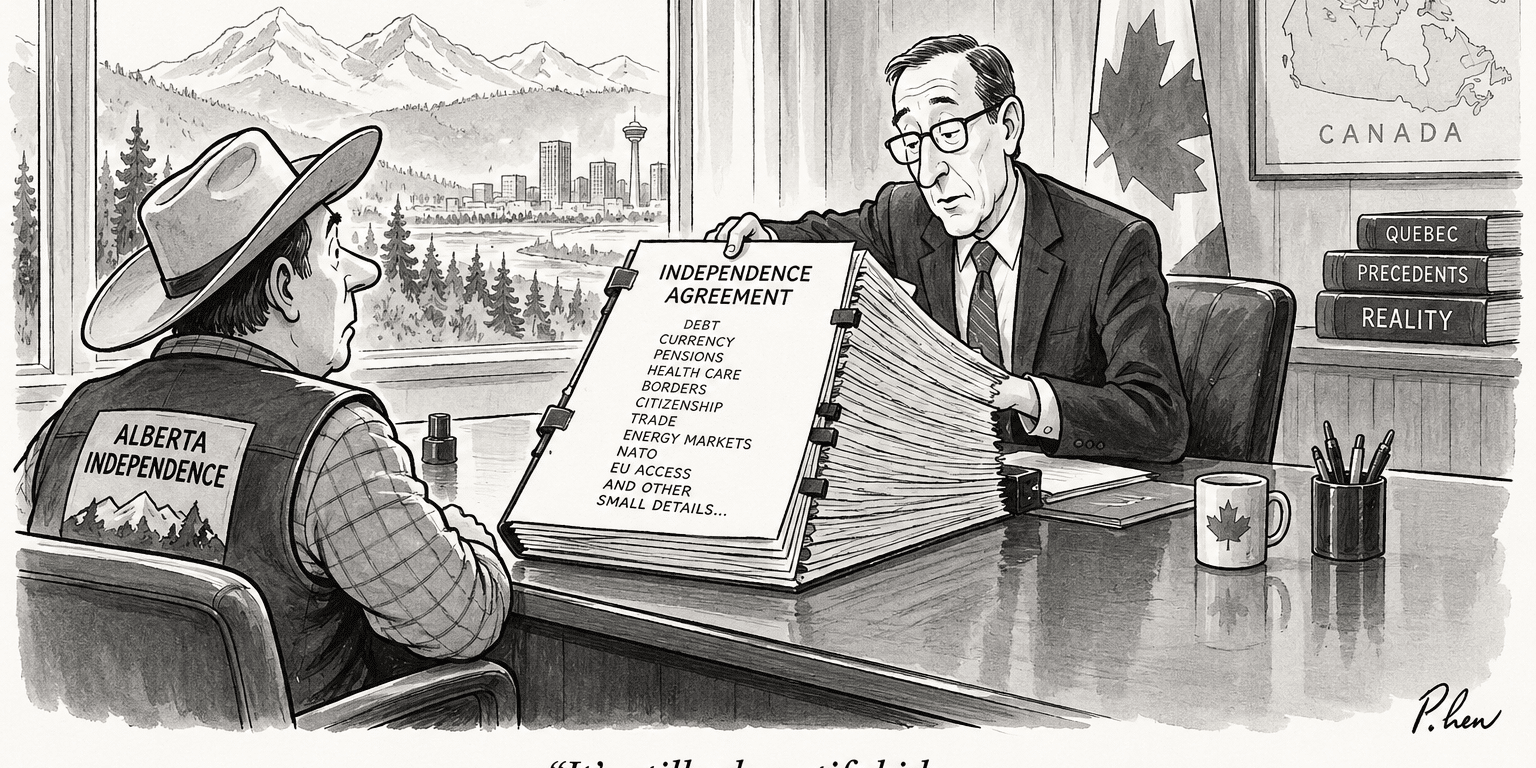
So for Nueva Tribuna I looked at what Alberta’s vote, and Canada’s experience with Quebec, might have to say to Spain and Catalonia. Independence may be a perfectly legitimate political aspiration, but eventually the poetry has to meet the accounting: debt, pensions, borders, citizenship, Europe and who pays the doctors the morning after.
And, briefly, I mourn my lost opportunity to become Alberta’s ambassador to Spain.
Read “La independencia: lea la letra pequeña” in Nueva Tribuna
Or the English version below.
Independence, Terms and Conditions Apply
Troy Nahumko
For a few weeks I had been quietly considering an ambassadorship. As an Albertan who has lived in Spain for two decades, I seemed well placed. The newly independent Republic of Alberta would need an embassy in Madrid, after all, along with embassies everywhere else where Canada had performed this expensive service on our behalf.
There were problems with my candidacy. I have never worked in the oil patch, which in the new republic might have counted as a character defect. And Alberta, reduced overnight from part of a G7 country of nearly 42 million to a landlocked nation of five million, would need diplomats better qualified than I am to persuade its neighbours to let all that oil, gas, beef and wheat cross their territory.
Alas, it was not to be.
On Monday, roughly 76 per cent of Albertans voted to remain Canadian. About 24 per cent voted to begin the legal process that could eventually lead to a binding referendum on independence.
That distinction matters. Albertans did not vote on independence. They voted on whether to start the process of holding another vote on independence. It sounds almost comically Canadian: before deciding whether to leave Canada, we held a referendum on whether to arrange a referendum on leaving Canada. There was probably a form involved.
But beneath the comedy lies something Spain might usefully examine.
Canada has stood at this cliff edge before. In 1995 Quebec came within 54,288 votes of choosing sovereignty, and this month Quebecers returned the separatist Parti Québécois to power. The 1995 scare produced one of the less romantic documents in the history of nationalism: the Clarity Act. Its insight is embarrassingly sensible: if you intend to dismantle a country, everyone should know what the question means.
A vague mandate to negotiate a better relationship is not enough. Nor is 50 per cent plus one automatically decisive: the House of Commons judges whether a majority on a clear question is clear, weighing the size of the majority and turnout. Even then, nobody gets a passport the next morning. As the Canadian Supreme Court had already ruled, a clear result creates a duty to negotiate, not a country. Assets and liabilities, borders, Indigenous and minority rights all go on the table, and lawful secession ultimately requires constitutional change.
This is where nationalism, which is exceptionally good at poetry, meets accountancy. The vote is the beginning of the divorce, not the settlement.
Critics in Quebec, and in Catalonia, might call this a veto for the centre. The objection has force, and Quebec legislated its own reply in 2000. But a veto over the question is not a veto over the answer, and the alternative is worse.
Independence movements tend to present sovereignty as a universal solvent. Corruption? Madrid. Housing? Madrid. Extremism? Madrid. Taxes? Definitely Madrid. The flag goes up and history starts again on a clean sheet. Except that the morning after, the hospitals still have to open.
Doctors and nurses must be paid. Pensions must arrive. Bonds mature. Someone owns the hospital, someone paid for the motorway, someone owes the debt that financed both. And the far right, the landlords, the speculators and the corrupt do not evaporate at the new frontier. Catalonia has produced all of them without help from Madrid: Jordi Pujol confessed to a hidden fortune in 2014, and his children now await a verdict. Independence changes a constitution. It does not improve the species.
The interesting question is not whether Catalonia could become independent. Of course it could; there are countries smaller, poorer and considerably less plausible. It is what Catalans would be voting to create, and to surrender. What share of the debt follows them? Which assets? What happens to pensions, civil servants, railways, energy networks?
And then there is Europe. The comfort of European separatism is the assumption that everything desirable will stay exactly as it was: independence, yes; inconvenience, no. Membership, citizenship, currency, trade and free movement are not details to settle after the flags are printed.
Canada’s law cannot answer these questions in advance, but it admits they exist. Britain showed the alternative in 2016: decide to leave first, discover what “leave” actually means later. Customs, Northern Ireland and the rights of Britons abroad then forced their way into the romance. The false promise fitted on a bus. The consequences required thousands of pages.
Alberta offers another lesson. The grievance is real. Western alienation was not invented by Elon Musk or an algorithm; I grew up with it. Ottawa redistributes the proceeds of western resource wealth while power sits thousands of kilometres away. But outsiders have noticed its usefulness. This month Musk, reacting to the Parti Québécois win, posted that Quebec, Alberta and Saskatchewan should all separate, and the Globe and Mail reported that US Republican operatives had met Alberta organisers to discuss strategy. Domestic grievances do not become imaginary merely because foreigners find them useful. But in the age of social media, a country’s fractures can quickly become somebody else’s opportunity.
An independent Alberta would also learn what geography means. Its exports must cross Canada or the United States to reach world markets. Five million people on an ocean of oil sounds formidable. Five million asking their neighbours’ permission to move it sounds different. Catalonia, admittedly, has a coastline.
Nor should Ottawa think the problem has vanished. Nearly one voter in four wanted to start down the road to separation. They are not (all) cranks, and the grievances remain.
There are two easy responses to separatism. One is to imagine that refusing to discuss it will make it disappear. The other is to believe that independence is a single glorious act rather than an enormous collection of consequences. Canada, after nearly losing Quebec, tried a third: you may ask the question, but the question must mean something.
Spain starts from a harder place, since its Constitution offers no door like the one Alberta walked through. But the principle travels. If Catalans are ever asked whether they want an independent state, let them be asked clearly, and let them see the answers beside the promises, as Scotland at least tried to do in 2014.
How much debt? Which assets? Which pensions? Which citizenship? Which currency? What relationship with Europe?
And who pays the doctors the morning after?
Perhaps, knowing all that, they would still vote yes. That is democracy. But at least they would know what they were voting for.
Independence is a perfectly legitimate political ambition.
It is not a magic trick.