The Facts, Monseñor…The Facts
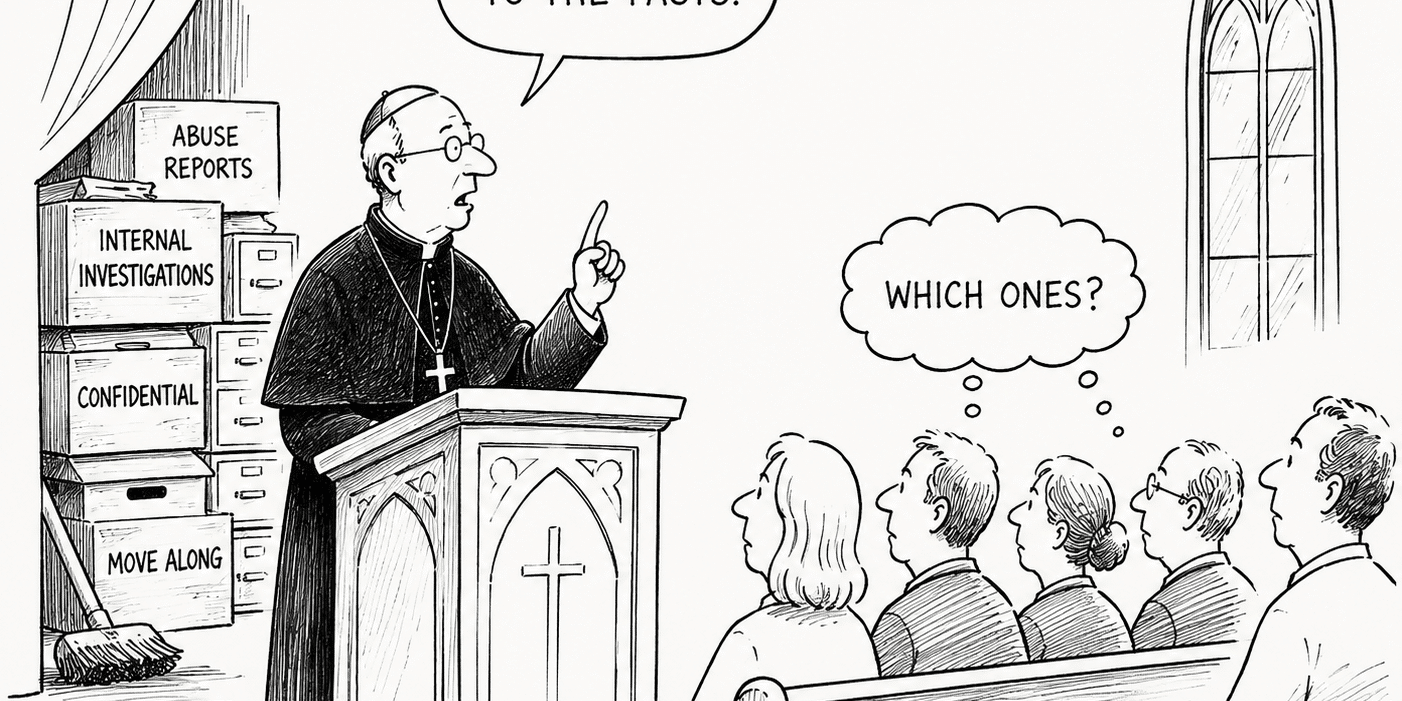
“I refer to the facts.”
That was the response of Archbishop Luis Argüello, president of the Spanish Episcopal Conference, when challenged about the Catholic Church’s handling of sexual abuse.
It’s a powerful phrase—but it invites an obvious question: Which facts?
That question is the starting point for my latest article, published in the Spanish newspaper Nueva Tribuna. Rather than debating intentions or public relations, it looks at the documented record: criminal convictions, institutional responses, and the persistent gap between what Church leaders say and what the evidence reveals.
Although the article focuses on recent events in Spain, the issues it raises are universal. Wherever institutions claim the moral high ground, they must be prepared to be judged by their actions rather than their words.
The original Spanish article in Nueva Tribuna can be read here:
“Los hechos, Monseñor… Los hechos”
https://www.nuevatribuna.es/articulo/sociedad/iglesia-catolica-hechos-monsenor-luis-arguello-abusos-sexuales/20260718181245252513.html
An English translation is available below.
The Facts, Monseñor…The Facts
Troy Nahumko
Let me get this straight. The head of an institution, the president of the Spanish Episcopal Conference, no less, a man who wakes up every morning in vestments heavier than the sins he’s paid to absolve, stood in front of a microphone this week and, quoting Saint Augustine like a man who thinks dead theologians can be used as a coat of Kevlar, announced that a state without ethics degenerates into a band of thieves. And when some poor reporter, doing the only decent thing left in journalism, asked him whether he was referring to the sitting government, Monseñor Luis Argüello did not blink. He did not deny it. He delivered the line with the flat, glassy confidence of a man whose entire profession is built on never once having to produce evidence for anything he claims to believe: a los hechos me remito. I refer you to the facts.
Fine. I’ll take the bait. Let’s refer to the facts. All of them. Every last rancid, drug-addled, hard-drive-full-of-unconscious-women fact of them, because on the exact same day, not the same week, not some loosely connected news cycle, the same twenty-four hours, a court in Málaga was busy sentencing one of Argüello’s own foot soldiers to fifty-two years for drugging four women unconscious, raping them, and filming it for what one can only assume was a private archive of the damned. Fifty-two years. Three counts of sexual assault with penetration, aggravated because the son of a bitch used the very trust his collar was supposed to represent as the delivery mechanism for the crime. Four more counts of filming women who were, in the words of one of his victims, “completely dead” while he was on top of them. The court didn’t buy the diocese’s argument that you could somehow peel the priesthood off the crime like a label off a bottle. The judges said, essentially: no, this man’s job was the weapon. The collar wasn’t incidental. The collar was the master key.
So here’s my question for the Monseñor, still glowing with Augustinian smugness somewhere in a well-appointed office in Madrid: which band of thieves, exactly, has a standard operating procedure, a documented, muscle-memory, institutional reflex, honed over decades on every continent it’s bothered to colonize with a diocese, of relocating its criminals instead of reporting them? Because I’ve read the receipts now, Bishop, and they are genuinely deranged, and they belong on a shelf next to your own scripture, which is a text, let’s remember, in which the God you serve orders the slaughter of entire cities for the crime of worshipping the wrong rock, and hands out the women left standing as spoils of war. You want to lecture the Spanish state on ethics using a book where Moses, fresh off a battlefield, is furious that his own soldiers left the enemy’s virgin girls alive instead of killing them along with everyone else, and orders them kept instead, divine spoils, distributed by lot, spared only for what happens next? That’s not a moral tradition, that’s a war crime with a leather foreskin binding. And you want us to take notes on ethics from the men currently administering it.
Here is what actually happened, and I want you to take a moment and ingest the sheer bureaucratic lunacy of it. In the winter of 2022, “Padre Fran’s” girlfriend found a hard drive in the apartment they shared in Melilla. What she found on it were folders, organized by victim’s name, like a serial killer’s spreadsheet, if serial killers used Google Drive. Women drugged into unconsciousness while he raped them on camera. She did what you’d think a normal human would do on discovering her boyfriend is a serial rapist with a filing system: she told people. She did what any self-respecting Catholic sleeping with her priest would do — she told a fellow priest. She told the vicar. She tried, repeatedly, desperately, to get an audience with the actual Bishop of Málaga. But he’s a busy man, and he never took the meeting. What he did do, while this woman was banging on the doors of the Diocese with a hard drive full of horror in her bag, was quietly transfer his priest out of Melilla, first to the mainland, then to a couple of sleepy towns called Yunquera and El Burgo, citing — and I want you to say this out loud, slowly, because it deserves the full weight of its own absurdity — “health reasons.” Health reasons! The man’s health was, evidently, robust enough to forego the Viagra and keep on drugging women; it was only his paperwork that needed a change of climate. It took this woman six more months of getting stonewalled by men in robes before she gave up on the Church entirely, packed the footage onto a USB stick, and walked it into a Melilla police station herself. Because apparently in the year of our Lord 2023 the only functioning moral compass in this entire story belonged to a scorned girlfriend and a beat cop.
And pay attention to the dates here, because the dates are the whole indictment. This did not happen half a century ago, back when boys were boys and priests had an understood, unspoken license with the flock. This happened after a succession of popes had already shed their crocodile tears on cue, called abuse a “plague,” and promised — publicly, repeatedly, with the cameras rolling — that the Church had changed. It happened, in fact, in roughly the same window as Pope Leo XIV’s own visit to Spain, where he stood in the Congreso de los Diputados calling clerical abuse a plague and demanding “justice and reparation” from his own bishops, and then went and demonstrated, in real time, exactly how much that sentence is worth. He met, privately, with six curated survivors, hand-picked through a Madrid archdiocesan program called Proyecto Repara, a program run by the very institution under investigation, vetting its own witnesses. Meanwhile the associations who’d spent years actually organizing survivors and dragging this scandal into daylight — ANIR, Infancia Robada Madrid, Lulacris… — were left standing outside the Nunciatura with signs, unacknowledged, uninvited, informed of nothing. One of them, Miguel Hurtado, who says he was abused as a teenager at the Abbey of Montserrat, requested a meeting. He got silence. The Pope then visited Montserrat anyway, had lunch with the monks, and didn’t mention the abuse. King Felipe VI, receiving the pontiff, offered the truly immortal line that the abuses were not “representative” of the Church. as if a few hundred documented predators and the bishops who filed them away under “health reasons” were a rounding error rather than the load-bearing wall. This is what forgiveness looks like when the forgiver gets to pick who’s in the room.
What is a scandal is that none of this registers as scandalous anymore. It’s an assembly line. And it’s the same assembly line, running on the same gears, that you’ll find grinding away in Boston, Los Angeles, Dublin, and half the dioceses of Bavaria, the same gag reflex, over and over, with the terrifying consistency of a Swiss guard’s watch: allegation surfaces, priest gets moved, paperwork goes soft-focus, and if a prosecutor gets close enough to smell blood, there is, conveniently, gloriously, insanely, an entire sovereign micro-nation next door with no extradition treaty and a two-thousand-year head start on the concept of sanctuary.
To put it into more terrestrial terms: imagine a student walking into a teacher’s office to report that a classmate had raped someone, and the teacher’s response was to take the accused out to dinner and hand him a promotion. We would burn that school to the ground and salt the earth beneath it. When the Church does the exact same thing, it gets called “health reasons” and a papal blessing.
And here, ladies and gentlemen, is where the irony stops being ironic and starts being something closer to a hallucination. Spain’s Justice Minister, Félix Bolaños, a bureaucrat, God help us, is the reasonable one in this story, wrote back to Argüello and asked, essentially, how the Church would feel if a government minister described the entire institution as a band of sexual predators, a los hechos me remito right back at you, Excellency. It was a good line. It also let the Bishop off far too easy, because the comparison isn’t even close to symmetrical. Spain’s government is a democracy that occasionally, inevitably, produces corrupt individuals — plenty of them, God knows, Moncloa has never been short of men on the take — and those individuals mostly get dragged in front of independent judges, independent prosecutors, and a press that doesn’t ask permission before publishing.
What the state does not have is a doctrine instructing officials to shield criminals from prosecution in exchange for eternal salvation. The Church does. And here is the part that should actually enrage you, believer or not: this isn’t a bug in the system, it’s the operating principle. A faith that offers unlimited, backstage-pass forgiveness for a whispered confession and a few Hail Marys was never going to produce an institution obsessed with earthly accountability — why would it? If God forgives everything, on condition of nothing but private contrition, then the entire architecture of consequence collapses into a conversation between one man and his own conscience, conducted in a wooden box, with no cop, no judge, and no victim anywhere in the room. That is not a moral technology. That is a loophole with incense burning in it. Every time a bishop chooses reassignment over disclosure, he is not betraying the faith, he is practicing it exactly as designed: sin, confess, absolve, repeat, and let the state’s grubby, secular, unforgivably literal-minded courts sort out the collateral damage, if they ever hear about it at all. Canon law comes bundled with its own private courts, its own confidentiality clauses, its own bishop-shaped blast radius of immunity, and an institutional gag reflex that treats a raped parishioner as a PR problem to be quietly triaged rather than a crime to be reported to the nearest cop.
Spanish law already imposes duties to report public crimes in specified circumstances. When a minister breaks the law, the law eventually, however slowly, comes for him. When a bishop breaks the law, the law discovers, with a kind of weary, practiced shrug, that it has already been out-lawyered by an institution that predates the concept of extradition itself, and that answers, when it answers at all, to a jurisdiction with its own zip code and no obligation to hand anyone over.
So no, Monseñor. A los hechos me remito does not land the way you think it lands, and I hope somebody in that press room had the nerve to say so. I’ve referred to the facts. Despite intense scrutiny of the diocese’s conduct, no bishop has been convicted, or, as far as the publicly available record shows, prosecuted, or concealment in this case. Not because nothing happened, God knows something happened, video of four women can tell you exactly what happened, but because your institution is so thoroughly, professionally practiced at keeping everything verbal, deniable, and gloriously undocumented that even a motivated prosecutor couldn’t nail the thing to the wall. That’s not innocence, Bishop. That’s a trade secret, protected better than the recipe for Coca-Cola, and infinitely better protected than the women whose trust you were supposedly in the business of earning.
Bishop Satué, to his limited credit, has since apologized “in the name of the Church” and promised to pay the victims regardless of the verdict — the decent instinct kicking in a decade late, the way it always does in these stories, arriving only after the trial has started, only after the cameras showed up, only after the only two people who behaved with anything resembling honor in this entire grotesque pageant turned out to be a heartbroken girlfriend with a USB stick and a National Police inspector doing his actual job. Not the vicar who heard her and didn’t believe her. Not the fellow priest who nodded along and did nothing. Not the bishop who wouldn’t take her call but found the bandwidth to sign a transfer order. Not, for that matter, a pope who can find the word “plague” for a crowd of legislators but can’t find an afternoon for a man who was abused at the abbey he just had lunch at.
A band of thieves, Monseñor? At least thieves know they’re stealing, and they don’t ask you to thank God for the privilege. Your institution called it a health transfer, filed it in triplicate, and went back to lecturing the rest of us about ethics.