Why I Wrote About Ceiling Fans (again!)
This week, Nueva Tribuna published my latest article, Fans Above Us: The Politics of “We Survived.“ An English translation appears below.
For non-Spanish readers, some context may help.
The article was prompted by comments from a Madrid government minister who suggested that extreme heat in classrooms could be a source of ‘inspiration’ and reminded everyone that previous generations survived hot schools. The cynicism was orange to say the least.
His argument (to use the word very loosely) fascinated me because I’ve spent time in schools in places like Laos, Yemen and the Gambia, countries that European politicians often invoke as symbols of poverty and underdevelopment.
Yet those schools had something the majority of Spanish classrooms still don’t: ceiling fans.
The piece starts with heat in schools, but it’s really about a much broader habit of mind: the tendency to treat preventable suffering as a virtue simply because previous generations endured it. “We survived” is often less an argument than an excuse.
And sometimes the most uncomfortable political questions begin with something as simple as looking up at the ceiling and asking why there isn’t a fan there.
The English translation follows below.
Fans Above Us: The Politics of “We Survived”
On heat, hypocrisy, and the spectacular cowardice of people with air conditioning
I am standing in front of a classroom full of teachers. Not children — teachers. Professionals. The people I am hired to train, the people who will carry whatever I manage to impart back into their own fiefdoms, back to the actual children, the ones this whole civilizational project is theoretically designed to serve. It is June in Spain, and I am watching them die.
Not literally. Though the heat has a quality, dense, unmoving, almost bureaucratic in its indifference, that makes you wonder how long before the distinction becomes academic. A teacher fans herself with a worksheet on classroom management. Another has achieved the stillness of someone who has mentally left the building while his body remains, sweating through its obligations. I look up. No relief. Just plaster and the quiet contempt of a government that has other priorities.
And my mind drifts, as minds do when the body is losing the argument with the climate, to a ceiling I saw years ago in a similar setting in rural Laos.
The school there had, by any honest accounting, almost nothing. Cracked walls, benches worn to a polish by generations of fidgeting children, some students sharing what could generously be described as a seat. The windows were open frames through which the humid air declined to move. And yet, up above — slowly turning, unhurried, utterly magnificent — ceiling fans. Not one. Several. Someone in that impoverished school in that impoverished country had looked at the children in their care and made a decision: not this. Whatever else we cannot give them, we will not cook them.
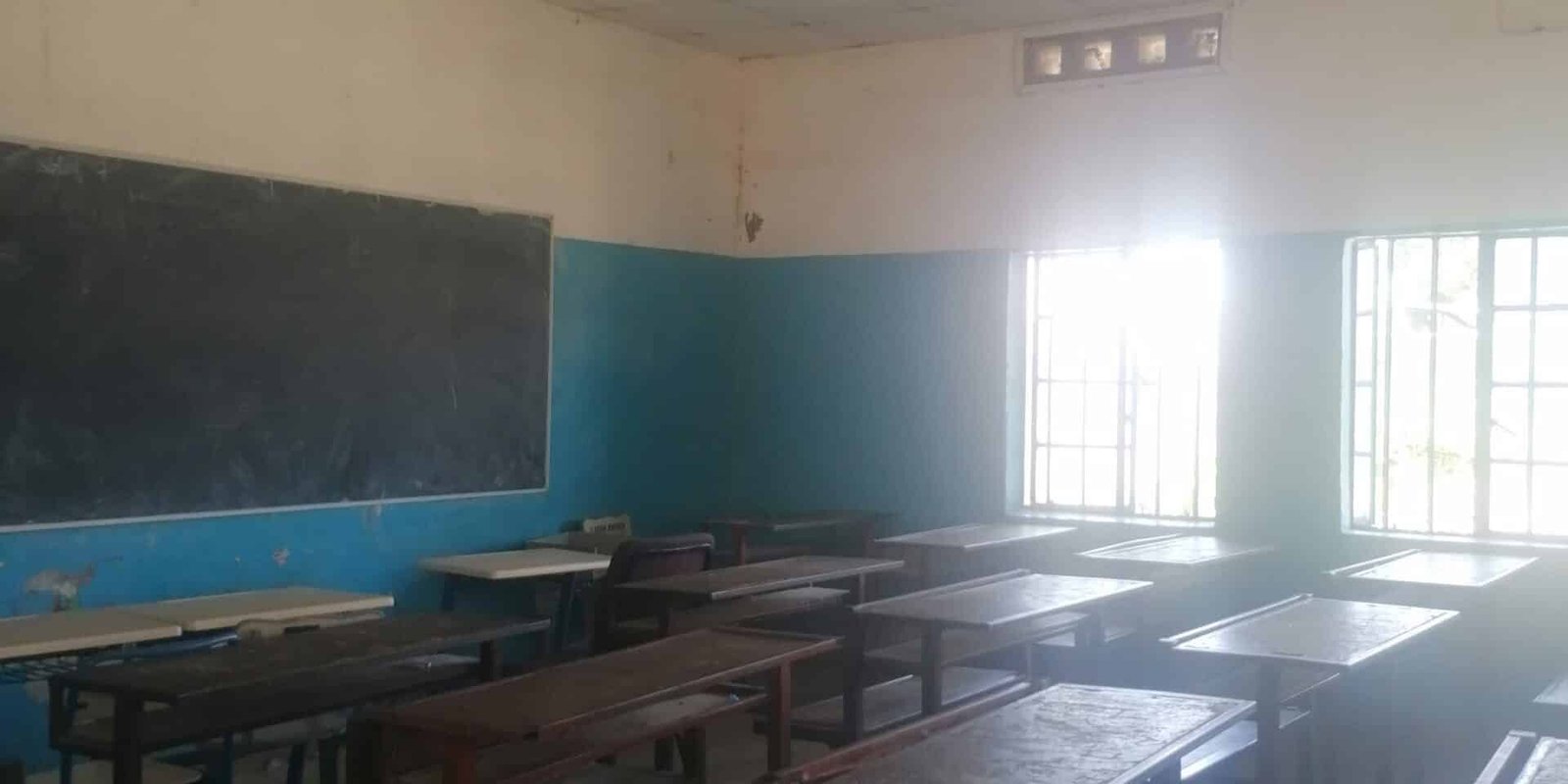
More recently, in the Gambia, a country so small and so poor that most Europeans couldn’t find it on a map and wouldn’t try, I visited a school of the most traditional organization imaginable. Blackboard. No chalk. Rows of desks like a photograph from 1933. And above the heads of those children, again, the slow revolution of ceiling fans. Turning. Caring. Present.
I look back at my Spanish ceiling. Nothing moves. Nothing cares. Welcome to National Priority.
Spanish politicians have long ignored this glaring absence, but the Community of Madrid’s recent response to this ongoing scandal has been, to borrow a word from a culture that actually produced some, duende — that dark, ineffable Spanish quality, except here it manifests as the dark, ineffable ability of people in power to look at a child wilting at a desk and feel absolutely nothing except irritation at being questioned about it.
The Education Minister, Mercedes Zarzalejo, informed parents this week that the regional government had invested “almost 18 million euros in climate conditioning.” Eighteen million. In a community whose annual budget runs to tens of billions. Then, apparently feeling that this triumph deserved a philosophical capstone, she added: “When it’s hot, it’s hot.” One is almost grateful for the honesty. Most governments at least pretend to be trying.
The true performance artist of the week, however, was Mariano de Paco, Councilor for Culture, a title that has never felt more hollow, who stood up in the Madrid assembly and, with the confidence of a man who has not been uncomfortable in years, cited a Murcian poet to argue that heat in classrooms might constitute “a source of inspiration.” He then, with the methodical thoroughness of a man dismantling his own reputation brick by brick, described how that very morning he had dressed his daughter in shorts and a short-sleeved shirt. “As we’ve always done,” he said.
It was a remarkable statement. For decades Spain has bristled whenever foreign writers describe it as a country suspended somewhere between modern Europe and a sepia-toned memory of itself. Spaniards are rightly irritated by travel writers who arrive for a long weekend, discover a few iron balconies, school uniforms, la indumentaria tradicional, and return home convinced they have wandered into a colorized photograph from another century.
Yet here was the Councilor for Culture making exactly that argument on Spain’s behalf. The classrooms are too hot? Children cannot concentrate? Teachers are reporting students slumped over their desks? Never mind. We survived. Our parents survived. The future, in this telling, is a problem because it differs from the past.
The solution, apparently, was shorts.
Teachers, who operate in the reality that Councilor de Paco has arranged not to visit, describe something rather less inspirational: students “literally slumped over their desks” telling their teachers “I’m sorry, I can’t.” Children begging to swap seats away from walls that radiate heat like a pizza oven. These are, the teachers specify with a kind of exhausted precision, excellent students. Top marks. The problem is not their character. The problem is physics.
But physics, unlike poetry, is apparently not within the councilor’s portfolio.
There is, of course, a Python sketch for this. There is always a Python sketch for this.
The Four Yorkshiremen spend their evening trying to outbid one another in misery. Not because they regret it, but because they are proud of it. Their childhood hardships become medals. Their society’s failures become personal achievements. By the end, they are practically accusing one another of having had it too easy.
Mariano de Paco’s contribution writes itself. You studied in a classroom that reached thirty-five degrees? Luxury. We sat in forty. You had a fan? We’d have killed for a fan. You had shade? You were spoiled. You managed to remain conscious throughout the lesson? The younger generation has no resilience.
The joke, and it is a very good joke, which is why it has outlasted most of the people who first laughed at it, is that enduring preventable suffering is not nobility. It is the alibi of those who had the power to prevent it and chose not to bother.
Mariano de Paco has apparently seen this sketch and concluded that he is not in it. He told the assembly that he himself studied the EGB in the Murcian heat and — here he paused, one imagines, for effect — “here we all are.” Survived. Thrived. Became a Councilor for Culture who quotes dead poets at sweating children. The system works.
The difference, the only difference, is that Cleese and Chapman and Jones and Idle were satirizing this impulse. They understood it as the moral abdication it is. The government of Madrid has taken the same material and built a policy platform.
The temptation is to treat this as merely ridiculous: another politician romanticizing discomfort because he no longer has to endure it. But the impulse on display here runs deeper than that.
Because a society reveals its priorities not only in whom it excludes, but in whom it neglects. The same political culture that shrugs at children wilting in classrooms has become increasingly fond of telling us who deserves Spain’s concern and who does not.
Which brings us to the phrase prioridad nacional.
Spain has, in recent months, developed a fondness for the latest euphemism in a long tradition of euphemisms — the velvet glove on the iron fist of the argument that some people, by virtue of birth, deserve more of this country’s consideration than others. It is, stripped of its euphemism, the same tired xenophobia that drapes itself in economics across the Western world, the same logic that sneers at migrants, that counts the costs of asylum and never the contributions, that looks at a person fleeing poverty or war or the particular hell of a failing state and sees, primarily, a burden.
These are the shithole countries, to borrow the clinical terminology of the movement’s American patron saint. The places from which civilization must be protected. The sources of the problem.
Except. Here is what I know from standing in those countries, from standing in their classrooms, from looking up at their ceilings.
In a rural school in Laos — GDP per capita roughly one-thirtieth of Spain’s, a country that has survived American carpet bombing, a Communist government of heroic economic incompetence, and decades of being nobody’s priority — someone looked at the children and put fans on the ceiling. In the Gambia, a country so comprehensively overlooked that its continued existence feels like an act of defiance, someone did the same. No poetry about inspiration. No press conference about the profound character-forming properties of sweating through your examinations. Just the quiet, radical, apparently revolutionary act of deciding that the children under their care should be able to think.
The people fleeing those countries, the people whom the prioridad nacional crowd eye with such theatrical suspicion at the borders of this great civilized nation, are arriving somewhere whose government cannot be moved to do what their home governments managed. They are entering classrooms less considered than the ones they left. And the Councilor for Culture is explaining that this is fine, actually, and also have you considered shorts?
One finds oneself, in darker moments, wishing that somewhere in this machine of indifference there existed a cousin. A brother-in-law. Some minor functionary with a financial interest in the ceiling fan industry, willing to trade a kickback for a contract. Because at least then the corruption would be productive. The graft would generate a side-effect: children who could breathe, teachers who could teach, classrooms that did not double as an experiment in the outer limits of human cognitive function under thermal stress.
Instead we have something purer and in its way more depressing: not venality but contempt. Not corruption but indifference. A government that genuinely does not care, has no cousin in the fan business to incentivize it to care, and has decided that this is fine because Mariano de Paco once sat through a hot lesson in Murcia and turned out, against considerable odds, to be exactly this.
When it’s hot, it’s hot. As we’ve always done. Here we all are.
In one of the wealthiest countries in Europe, watching teachers fan themselves with worksheets while a ceiling that could hold a fan holds nothing, offers nothing, turns for no one. Somewhere in the Gambia, a fan turns slowly above a classroom. It does not inspire. It does not quote poetry. It does not explain why suffering is good for character. It is simply doing its job.
Which is more than can be said for almost everyone else in this story.