Judas Lights
Spain is currently gripped by yet another political corruption scandal, and as always the debate has quickly moved beyond individual wrongdoing to broader claims about the moral bankruptcy of the left itself.
That reaction prompted me to write Judas Lights. The piece argues that there is a crucial difference between a corrupt politician and a corrupt idea. Individuals can betray the principles they claim to represent; that does not mean those principles were meaningless from the start.
Using the story of the so-called “Judas lights”, false lanterns used to lure ships to their destruction, I explore political cynicism, the President of Extremadura, María Guardiola’s lighthouse attacks on the Spanish left, and why some people seem incapable of distinguishing between personal failure and ideological purpose. Read the Spanish version in Nueva Tribuna here.
The original English version follows below.
Judas Lights
On María Guardiola, Spanish Political Corruption, and the Difference Between a Bad Person and a Bad Idea
Troy Nahumko
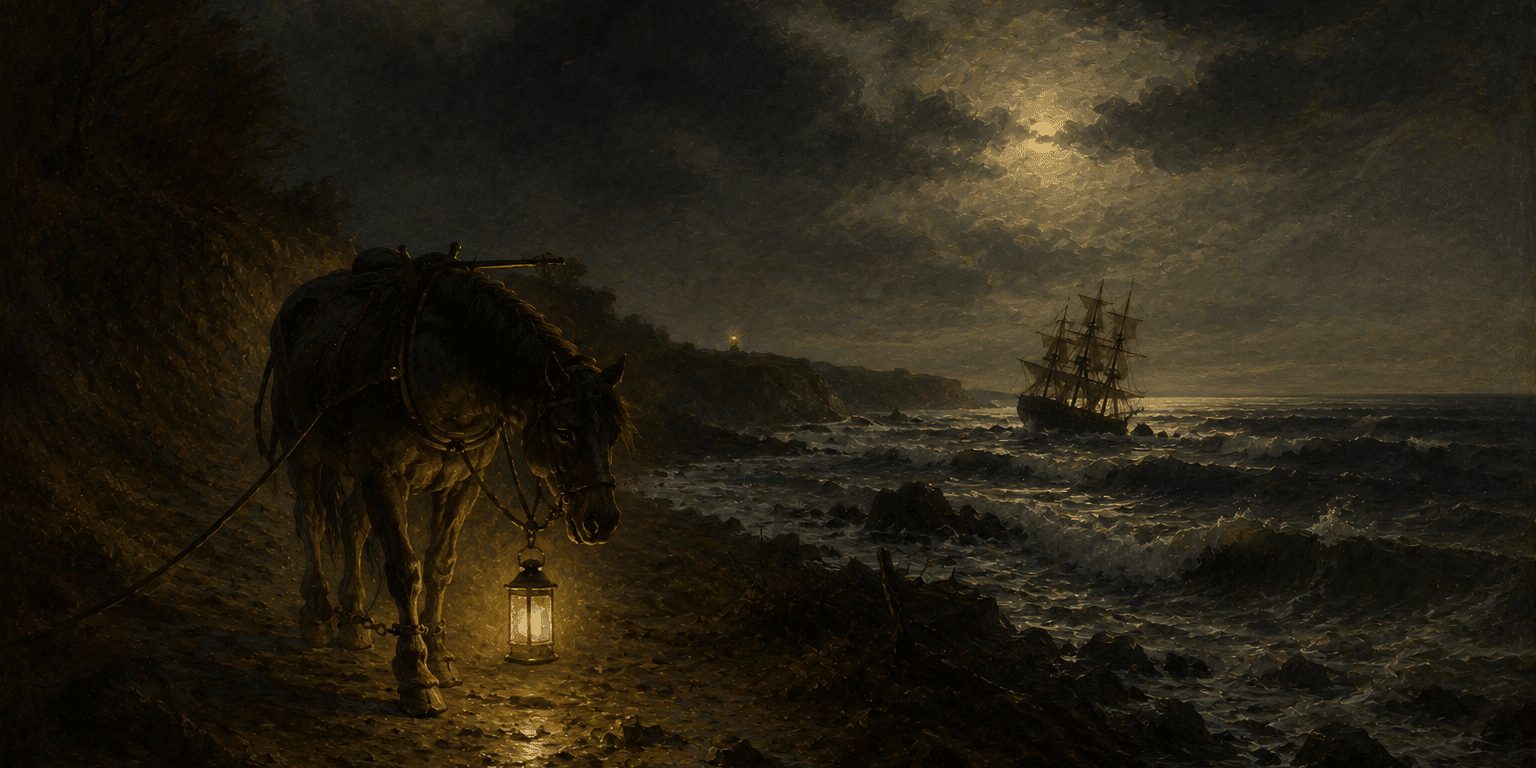
Picture the Carolina shore, sometime in the colonial darkness of the eighteenth century. The night is moonless, the wreckers preferred it that way, which is how they earned the name mooncussers: men who cursed the moon for its inconvenient honesty. A lantern was tied beneath the neck of a horse, a rope attached to one of its legs, and the animal was walked slowly up and down the dunes. The uneven gait made the lantern swing with the easy, reassuring rhythm of a ship riding at anchor in a sheltered harbor. Out at sea, an exhausted captain would see that warm, bobbing light, feel relief move through him like a warm current, and steer toward it. What waited for him was not shelter. It was wreckage. It was pirates on the beach, patient as gulls, waiting for the sea to deliver them someone else’s cargo.
They called these lanterns Judas lights. The place took its name from the old nag led endlessly up and down the shore: Nags Head, North Carolina. A place named, in other words, for a deception so well-rehearsed it became geography.
Spain offers ample occasion to think about false lights.
María Guardiola, President of the Junta de Extremadura, parroting her party’s line, recently declared that the Sánchez government is acabado. Finished. She spoke of moral bankruptcy on the left, of a progressive movement exposed as hollow, of a faro moral — a moral lighthouse — revealed to be nothing of the sort.
One must admire the timing. Not morally, of course. Artistically.
This is the same María Guardiola who stood before the voters of Extremadura and swore, with the full theatrical conviction of someone who means it completely until the moment they don’t, that she would never — not under any circumstances, not over anything less than her own political corpse — govern alongside the far right. With a party that campaigns against migrants as a matter of platform. A party whose hostility to LGBTQ citizens is not an unfortunate fringe position but a central, proudly-held article of faith. Days after the election, having apparently survived her own political death with remarkable stoicism, she formed that very government.
And now she speaks of moral lighthouses.
There is a Spanish proverb that does the heavy lifting here: Piensa el ladrón que todos son de su condición. The thief believes everyone shares his condition. It is the defining cognitive error of those who experience public life as a private market: they cannot conceive of any other motivation. Ideology, to them, is merely a costume worn over the same naked ambition they themselves carry. When they see a progressive politician accused of corruption, they do not see an individual who betrayed his principles. They see confirmation that principles never existed.
This is a comfortable theory. It is also, demonstrably, wrong.
Yes. There are individuals on the progressive side of Spanish politics who have behaved criminally. Many. This is not in dispute. No institution in human history — no party, no church, no army, no family — has been sealed against the entrance of scoundrels. Scoundrels are adaptive. They go where the opportunities are. And power, wherever it lives, is an opportunity.
But here is the difference that Guardiola and her coalition would prefer you not examine too carefully:
A progressive politician who steals acts against everything their movement stands for. The corruption is a personal betrayal, of the voters, of course, but also of the very principles that gave their career its justification. A corrupt progressive is a person violating the principles they claim to hold. A reactionary opposing social progress is simply arriving to work on time.
When the Spanish right stands against progress, it is not acting against its values. It is expressing them.
This is not name-calling. It is not polemic. It is a simple, documented, unbroken historical record.
Divorce, legalized in 1981 — they fought it. Public education expanded to reach every child regardless of means — they fight it. Raising the minimum wage to levels at which a human being can actually live — they fight it. Same-sex marriage, 2005, while the world watched and the predicted civilizational collapse failed, as usual, to arrive — they fought it with every procedural and rhetorical instrument available. Domestic violence legislation. Labor protections. Healthcare as a right rather than a privilege. Protections for historical memory. Did I miss one? Every single time, without exception, they are on the wrong side. Not once. Not occasionally. Every single time.
And every single one of these things is now — here is the word that matters — normal. Children grow up in Spain today blissfully unaware that there was once a serious political movement that went to the barricades to prevent their mothers from leaving their abusive husbands. The lighthouse, the real one, is always slightly ahead of where the ships currently are. That is precisely what makes it useful.
We are, at our core, a social species. This is not ideology. It is biology. Our genes did not construct us for isolated self-sufficiency, they built us for cooperation, for the commons, for the understanding that we survive and flourish not by accumulating against one another but by building together. There is no virtue in selfishness. There is no wisdom in it either. You can read all the Ayn Rand you like. The penguins will still huddle.
The mooncussers of Nags Head were eventually undone not by moral argument, to which they were entirely immune, but by the construction of actual lighthouses. Tall. Fixed. Publicly funded. Burning for the benefit of everyone, including people the lighthouse keeper would never meet. Real light, in sufficient quantity, makes false light redundant.
María Guardiola and her cadre swing their lanterns in the dark, and some ships will steer toward it. They generally do, for a while. But a light that moves with the gait of an animal trained for deception is not a lighthouse. A harbor that wrecks you is not a harbor.
And a party that has been on the wrong side of history without exception is poorly placed to lecture anyone about moral lighthouses.
It just gets to curse the moon.