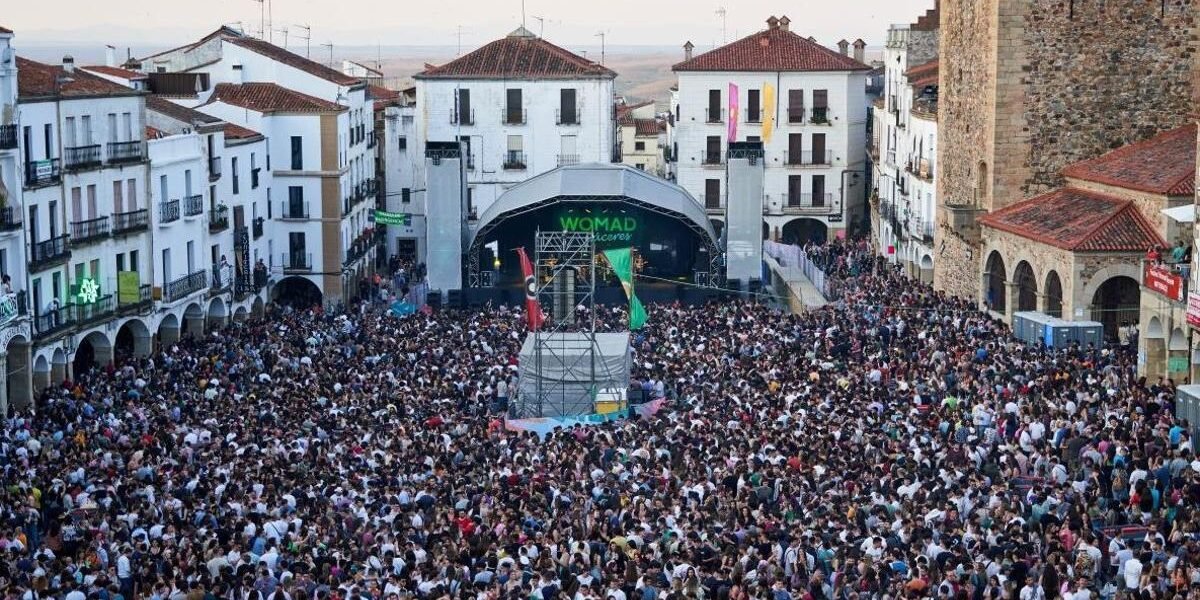
What Happens in WOMAD Stays in WOMAD
Cáceres undergoes a curious transformation every spring.
For one weekend, the medieval city fills with African percussion, NGO stalls, craft beer, dreadlocks and the language of global citizenship as WOMAD, the travelling world music festival founded by Peter Gabriel, arrives in town. Officially, it is a celebration of multicultural openness and artistic exchange.
In reality, at least here, WOMAD serves a different purpose.
It is the city’s annual pressure valve.
To understand that, you have to understand Cáceres itself: a conservative provincial city with the social memory of a village. A place where everyone still seems to know everyone, where reputations linger for decades, and where the collective gaze exerts a quiet but constant pressure.
For one weekend each year, that pressure eases.
Young people dress a little differently. Drink a little more. Flirt more openly. Experiment cautiously with identities they will mostly fold back into storage by Monday morning. The festival creates anonymity in a city not naturally designed for it.
The irony is that most people barely watch the bands.
They stand in corrillos, tight conversational circles, with their backs to the stage while musicians from Benin, Bolivia or Birmingham perform to a sea of shoulder blades. Years ago I used to complain endlessly about the botellón culture surrounding WOMAD, the industrial-scale public drinking that often seemed to overwhelm the music entirely. To his credit, the current mayor’s only memorable move may be that he was the first politician willing to seriously confront the problem.
And yet the essential geometry remains unchanged.
The backs still face the stage.
Because the group is the real event.
WOMAD presents itself as a radical opening to the world, but what it actually offers is a temporary suspension of local social rules. A conservative city rehearsing openness for a weekend without fully committing to it.
There are contradictions everywhere. The festival wraps itself in the aesthetics of anti-commercial cosmopolitanism while consuming enormous public subsidies, only a fraction of which actually reaches the musicians. There is something more than faintly colonial in the spectacle of curated “global authenticity” imported into one of Spain’s poorest regions for European consumption.
And yet dismissing WOMAD as hypocrisy would miss why people here defend it so fiercely.
The festival works.
Not because of the music, necessarily, but because it allows the city to briefly become another version of itself before safely returning to normal on Monday morning.
Read the Spanish version of the article in HOY here or the English original below.
What Happens in WOMAD Stays in WOMAD
The corrillo forms with an instinctive geometry. They stand in tight planetary clusters, self-organizing, self-sealing, backs turned to the stage with a unanimity deeper than deliberation. The band, some ensemble from Benin, Bolivia or Birmingham, wherever the festival curators have gone fishing for authenticity this season, plays to a sea of shoulder blades. This is not indifference. This is simply the local unconscious asserting its oldest priority: the group is the event. Everything else is support act.
And here is where WOMAD performs its most exquisite trick. The festival sells itself as the antidote to all of this, openness, the corrective passport stamp for the landlocked Extremeño soul. What WOMAD actually delivers, with magnificent inadvertence, is a new group to belong to.
Two young women drift to the edge of their corrillo like molecules approaching a phase change. They are dressed as Cáceres dresses — careful, ironed, everything chosen to signal belonging without the vulgarity of individual expression. But there is an accessory: a scarf, boldly patterned, knotted at the hip with the tentativeness of a question not yet fully formed. Back in the closet by Monday, one suspects. One holds the maceta, the plastic chalice passed like a rosary. They are building courage.
The true gift of WOMAD, its contraband sacrament beneath the corporate branding, is anonymity. Cáceres is a city with the memory of a small village and the ambitions of a larger one. The fur-coated women who occupy the afternoon caña hour like a distributed surveillance network have catalogued every deviation in the sediment of collective disapproval. For one weekend a year, the archive crashes. Those grandmothers are not here and that is enough.
This is the city’s deepest irony, the one that Semana Santa and WOMAD share without acknowledging each other. Both are theaters of collective identity. Both have sponsors. The upstanding families who wear their Christianity like a title deed and carry the approved edition of the Gospel, the one pruned of its more inconvenient passages, would be horrified by the comparison. WOMAD, to their mind, is what happens when standards slip. They are not entirely wrong. It is what happens when conventions slip, and it is glorious.
The soundman buries the soloists in sonic mud, whether by instinct or private conviction, levelling brilliance into communal pulse. The throbbing rhythms survive this. They move through the crowd below the level of language, below family name and the long memory, addressing something older and less judgmental.
The two young women have done everything correctly. Baptism. Catechism. The patient auxiliary role in the processions. The polo-shirted novio doing his Master’s in Madrid. The life obediently fed into the oposición barometer at the approved velocity.
They have, in short, been excellent.
A space opens in the crowd.
They step into it, together.
You can shrink-wrap the music and dress the enterprise in the language of global citizenship. The pressure valve still works. It works because the pressure is real — laid down in layers by a city that has always insisted that the group is everything and the individual is a rumor. The valve closes. Monday arrives and its correct behavior restored, as if none of this ever happened.
Which is why it has to happen again next year.